
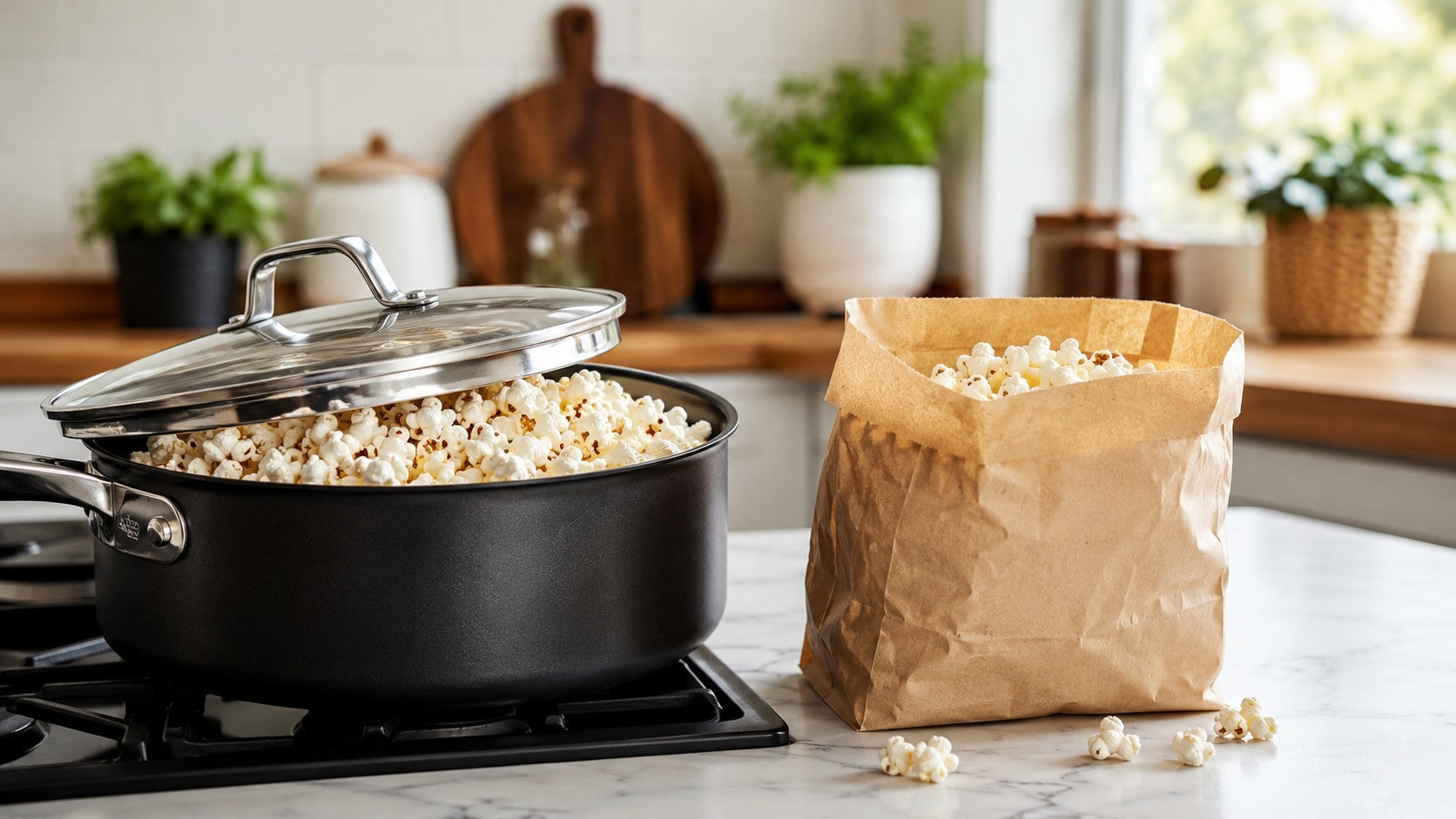
Popcorn in a Pot vs. Bag – What's Really Better?
If you've ever found yourself standing in the kitchen in the evening with a bowl of kernels in hand, wondering "what now?", microwave popcorn vs. stovetop popcorn isn't just a matter of taste. It's a choice between time and effort, between real control over ingredients and convenience, and between an enjoyable homemade snack and another task to clean up after.
Popcorn is one of the simplest snacks there is, but the way you prepare it changes almost everything. How much oil goes in, how much salt sits on each kernel, how many dishes get dirty, and even how you'll feel after the bowl. So the right question isn't what's more "authentic" or what's "faster," but what works in real life.
Stovetop Popcorn vs. Microwave Popcorn: The Difference Starts with Control
With a pot, you have complete control. You choose the type of oil, the quantity, the type of kernels, the roasting level, and the seasoning you add at the end. For those who enjoy standing by the stove, listening to the popping, and customizing the result exactly to their taste, it's quite an experience. There's something homely, a bit ritualistic, and especially flexible about it.
But full control also means full responsibility. If you use too much oil, the popcorn comes out heavy. If the heat is too high, some burns and some remain unpopped. If you don't shake it at the right time, you get a mixture of bitter pieces and unopened kernels. In other words, with a pot, you can achieve an excellent result, but not always without experience, attention, and staying put.
In a dedicated microwave bag for home preparation, the story is different. There's no need to manage the popping process every second, and no dependence on a good pan or a precise hand. If the bag is designed for kernels only, without built-in additives or unnecessary industrial layers, it offers something very interesting: the convenience of a bag, with control that's close to homemade. This is exactly the area where many households are looking for a solution.
What Happens to Your Health with Each Method
Here it's important to be precise. Popcorn itself, when made from simple corn kernels, can be an excellent snack. The problem starts with what goes in with it. In a pot, the healthiness of the result depends on you. A little oil and measured seasoning will yield a lighter bowl. A lot of oil, melted butter, and a free hand with salt take it to a completely different place.
The big advantage of a pot is that you know exactly what goes in. No surprises. On the other hand, in practice, many people pour oil "by eye," making it hard to control the quantity. What looks like a little at the bottom of the pot quickly turns into popcorn that feels greasier than you intended.
A ready-made industrial microwave bag usually solves the effort issue, but not always the ingredient issue. Sometimes it comes with oils, flavorings, sodium, and packaging that not everyone feels comfortable with. Therefore, when talking about microwave popcorn bags, you need to differentiate between a ready-made bag that dictates everything to you, and a dedicated paper bag to which you add only kernels and seasoning of your choice.
In simple terms: if your goal is a cleaner snack, the healthy way is not just to choose between a pot and a bag, but to choose how much control you have over what goes in. Ecopop bags work without a drop of oil, without plastic coating, and without PFAS, so the salt and seasoning remain your decision at the end of the process.
True Convenience Isn't Just Preparation Time
On paper, stovetop popcorn doesn't sound complicated. A few minutes, a lid, a little oil, and that's it. In reality, there are a few more steps involved. You need to stand by the stove, listen, shake, open carefully, transfer to a bowl, and then deal with a greasy pot, a stove that caught a few popping kernels, and sometimes even a floor that received a festive scattering.
It's not terrible, but it does add up. Especially when it's a quick dinner with kids, a late-night snack, or a moment when you just want something small without turning the kitchen into a project.
A good microwave bag changes precisely this point. It shortens not only the preparation time but also the number of decisions, mishaps, and cleanups. You fill it, close it, heat it for 2-3 minutes, and it's ready. Fewer dishes, less grease on your hands, less feeling that you need to "prepare" to make something simple.
For those living at a fast pace, this is no small bonus. This is why a convenient solution manages to remain part of the routine, and not just a good idea forgotten after two tries.
Stovetop Popcorn vs. Microwave Popcorn, What About the Taste?
Some will swear that stovetop popcorn always tastes better. Sometimes that's true. The direct heat and the ability to play with the roasting can give a slightly deeper and more roasted flavor. If done correctly, the result is very rich, especially when seasoning is added immediately after.
But here too, there's an asterisk. Good taste depends not only on the method but also on consistency. When some kernels pop early and some late, and when the pot's heat isn't always perfectly distributed, the taste can be less consistent. Part of the bowl is great, part is acceptable, and part is a bit off.
In a dedicated bag, especially when using quality kernels and adding seasoning after preparation, you can get a surprisingly good result: airy, uniform popcorn that's easier to build flavors on. Fine salt, smoked paprika, nutritional yeast, cinnamon, even a little olive oil after popping—it's all in your hands.
The point isn't that one method is absolutely "tastier." The point is what you're looking for. If you enjoy the preparation itself and want to play with the heat, a pot will feel right. If you want a clean, fast, and consistent base that you can season however you like, a dedicated bag will do an excellent job.
Waste and Packaging Materials Also Matter
In recent years, more and more people are looking not only at what they eat but also at what their food is packaged in. This is a welcome change, because food packaging has real significance, both at home and beyond.
With a pot, there's almost no packaging, which is a clear advantage. You work directly with the kernels, without any additional wrapping. On the other hand, if the alternative is a simple paper bag without plastic, without aluminum, without PFAS, and without industrial coatings, a new balance is created. Suddenly, you don't have to choose between convenience and a clear conscience.
That's exactly why we designed Ecopop bags. They provide a shorter way to make popcorn at home, without carrying the familiar drawbacks of industrial microwave bags. You pour, close, pop. Simple in terms of use and materials.
When a Pot is Still the Right Choice
No need to pretend, there are situations where a pot is an excellent solution. If you're making a particularly large quantity, if you like manual control at every stage, or if making popcorn itself is part of the fun, the pot offers a freedom that's hard to beat. It's also suitable for those who have already developed a consistent method and manage to achieve precise results almost without thinking.
There are also people who simply enjoy the direct interaction with food. The rhythm, the smell, the feeling of "I made this." For them, a few minutes by the stove are not a chore but a good break in the middle of the day.
In other words, a pot is not an outdated method or a problem that needs to be solved at all costs. It's simply less suitable when you're looking for speed, consistency, and cleanliness with minimal fuss.
When a Bag is the Smarter Choice
If you make popcorn often, the difference is quickly felt. What seems like a small shortcut becomes a convenient habit. Instead of postponing preparation because you don't have the energy to wash a pot or stand by the stove, you just make it. And that's the whole story.
A dedicated bag is especially suitable for families who want a quick snack without a long ingredient list, for students looking for a clean solution in a small kitchen, for those trying to reduce oil and salt without losing the fun, and for anyone who likes to customize flavors themselves. It's also excellent for effortless entertaining: one base, several seasonings, and everyone builds their own unique bowl.
This isn't a compromise between homemade and industrial. When done right, it's a way to enjoy the best of both worlds: quick and convenient preparation, with ingredients you control.
Why Ecopop Bags Beat the Pot for Everyday Use
Ecopop bags are made of paper without plastic coating and without PFAS, and the unique closure keeps them sealed while the kernels pop. No oil, no jumping lid, and no kernels rolling onto the stove.
You fill them with your own kernels, microwave for 2 to 3 minutes, and season at the end exactly how you like it. The bowl is ready before the pot would even heat up.
- Faster: 2 to 3 minutes versus preparing and standing by the stove
- Cleaner: No greasy pot, no dirty stove, no dishes to wash
- Oil-free: Popcorn pops with heat alone
- More consistent: Fewer burnt kernels and fewer unpopped kernels
You can start with the Ecopop home natural popcorn bag pack, and complete it with mushroom variety corn kernels that pop large, round, and crunchy.
So Which Is Better?
Stovetop popcorn vs. microwave popcorn is not a test of right or wrong. It's a question of suitability. If the ritual, direct contact, and full manual control are important to you, a pot can be an excellent choice. If less mess, less time, more consistency, and convenient ingredient control are important to you, a dedicated paper microwave bag will probably be more suitable for real life.
The best question to ask is not how to make the most "invested" popcorn, but how to make popcorn that you'll want to make again tomorrow. When the solution is simple, clean, and tasty, it's much easier to make good choices in your daily routine, and that's exactly what the Ecopop bag pack is designed for.
Read more

When looking for a simpler solution for preparing food at home, unlined paper food bags sound like an obvious choice. But this is exactly where it's worth pausing. Not every paper bag is suitable f...
There's a moment in the afternoon when hunger doesn't ask for a meal, it asks for something small, quick, and satisfying. That's exactly when most of us reach for whatever's in the cupboard, not wh...