
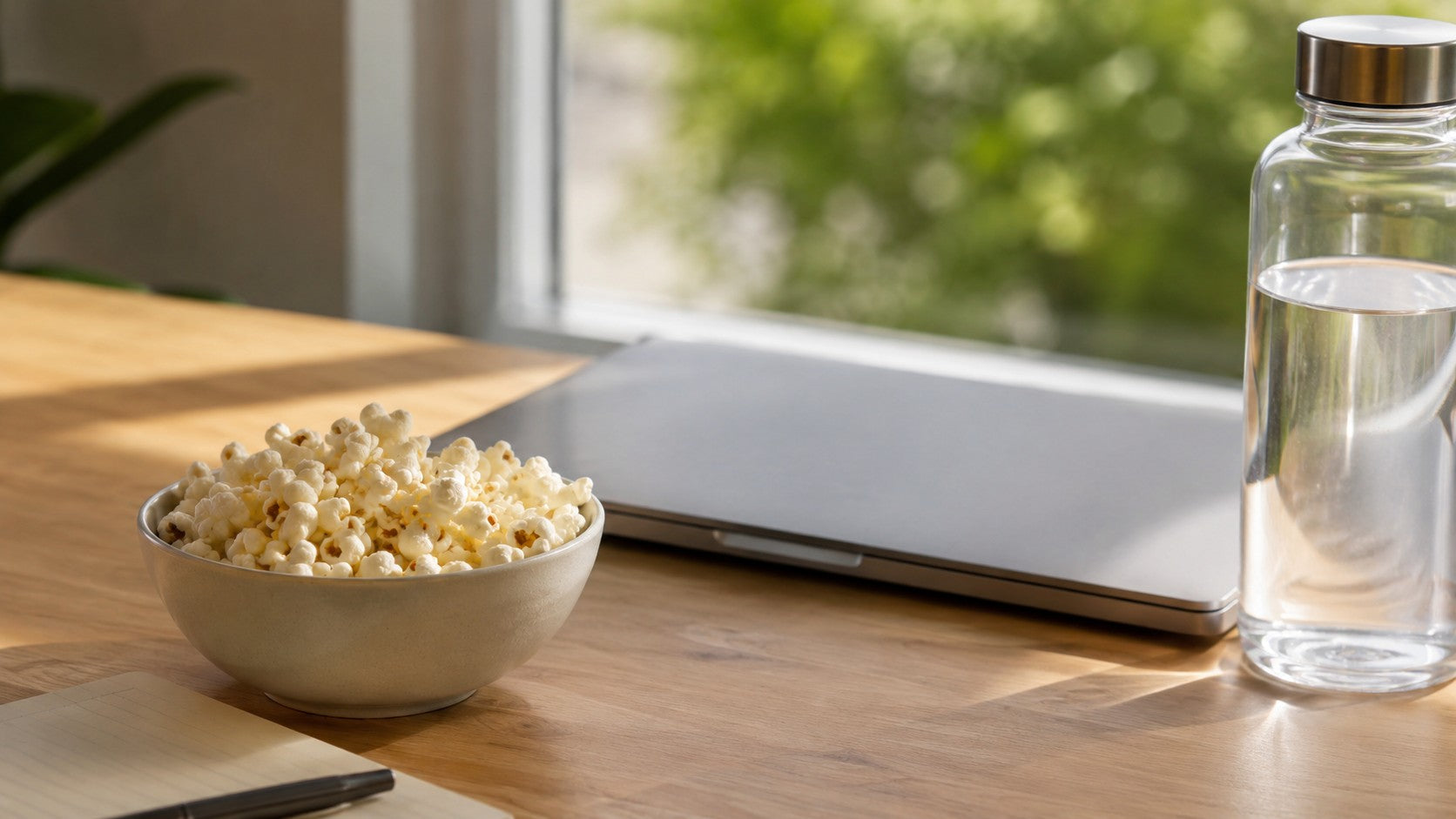
A healthy snack that actually works in your daily routine
There's a moment in the afternoon when hunger doesn't ask for a meal, it asks for something small, quick, and satisfying. That's exactly when most of us reach for whatever's in the cupboard, not what truly does us good. A healthy snack isn't a test of willpower, but a smart choice that fits real life: when there are kids at home, when you come home tired from work, when you need something while watching a screen, or when you feel like snacking without feeling like you've lost control.
The problem is that not everything that seems light actually is. Many snacks are marketed as "baked," "thin," or "natural," but in reality, they come with a long list of ingredients, a lot of sodium, unnecessary oils, and a taste that makes you eat without noticing. If the goal is to find a snack that fits well into your routine, you need to think less about headlines and more about what's inside, how it's prepared, and how much control you truly have.
What Makes a Healthy Snack a Good Choice
A good snack doesn't have to be perfect. It needs to be simple enough that we'll actually eat it, satisfying enough that we won't look for something else ten minutes later, and clean enough that we'll feel good about it both while eating and afterward. In other words, health is only part of the equation. Convenience, quantity, and ingredients are just as important.
In practice, a healthy snack is one based on familiar ingredients, with a minimum of unnecessary additives. It doesn't have to be extremely low in fat, but it's preferable if it allows for control over the amount of oil, salt, and seasoning. This is a critical point, because often the problem isn't the food itself, but what's added to it along the way.
The feeling of satiety also matters. A snack based solely on simple sugar or processed flour will give a short boost and then a crash. In contrast, a snack with good volume, satisfying texture, and precise flavor can fill a gap without turning into an unnecessary meal.
Why Even Healthy Snacks Fail in Reality
Most people don't need more nutritional information. They need a solution that works when the kitchen is messy, when the kids are hungry now, or when studying continues late into the night. This is precisely where the compromise is born: choosing what's ready, packaged, and accessible, even if there's less control inside than we'd like.
And it's not just a matter of health. It's also a matter of hassle. If preparing something good requires a pan, oil, mixing, supervision, and cleaning afterward, the chances of doing it again and again simply decrease. Therefore, a truly healthy snack is one that doesn't require unreasonable effort. It needs to fit into the day, not manage it.
There's also the matter of feeling. People want to snack with pleasure, not feel like they're eating "compromise food." Once the texture is good, the smell is inviting, and the taste is precise, it's much easier to stick with it. When a healthy snack feels like a compromise, it lasts two days. When it's tasty and convenient, it becomes a habit.
Homemade Popcorn: A Smarter Solution Than It Seems
Over the years, popcorn has gained the image of a movie snack, but at home it can be exactly the opposite: a clean, simple, and precise snack. Its big advantage is the base: kernels. Not a mysterious mixture, not butter-flavored powder, not a greasy layer you can't understand where it came from. When you start with just kernels, everything else is in your hands.
This changes everything. You can make popcorn with very little oil or none at all, decide how much salt you really need, and add flavors that suit children, entertaining, or just an evening watching a series. It also gives good volume relative to the quantity, so it fits perfectly in that space between "I want something" and "I didn't mean to eat a meal now."
For this to happen every evening anew, the preparation must be truly short. At Ecopop, we developed Ecopop bag pack for natural homemade popcorn exactly for this purpose: pour kernels into a paper bag, close it, put it in the microwave for 2-3 minutes, and season it at the end exactly as you like.
On the other hand, even here there's a big difference between popcorn you make yourself and ready-made versions. Once someone else has decided for you on the oil, salt, additives, and packaging, you've lost what makes it a good choice in the first place. Therefore, the question is not just whether popcorn can be healthy, but how it's prepared.
How to Choose a Healthy Snack Without Falling for Marketing
The simple way to check if a snack is right for you is to ask three questions. The first is how much control you have over the ingredients. The second is whether it's truly convenient to prepare or consume. And the third is whether you'd want to eat it again in a week.
If the answer to the first question is weak, there's a problem here. Products that rely on ready-made flavors, hidden oils, or overloaded ingredient lists create a sense of convenience, but reduce the ability to truly choose. In contrast, when the base is simple and you add what's needed, the level of control immediately increases.
If the answer to the second question is weak, that's also a warning sign. Healthy food that's not convenient to prepare remains a nice idea. A good solution needs to be quick, clean, and clear. Without a pot that gets dirty, without unnecessary supervision, and without feeling that every small snack is a project.
And regarding the third question, it might be the most important. A healthy snack needs to fit life, not just intentions. If the taste isn't satisfying, if the texture is disappointing, or if the preparation is cumbersome, it won't last. Health that doesn't pass the test of everyday life remains on paper.
Healthy Snacks for Children and Adults Don't Have to Be Two Separate Worlds
In active homes, there's a constant challenge: finding something that both kids will want, adults will feel comfortable with, and that won't turn the kitchen into a battlefield. This is precisely why simple solutions win. When you can prepare one base and play with the seasoning, everyone benefits.
Homemade popcorn is an excellent example of this. For children, you can go for a mild and familiar taste; for adults, you can add a little spice, nutritional yeast, smoked paprika, or a dry spice mix. The base remains clean, and the experience feels personal. Instead of another generic snack, here's something that starts simple and ends exactly as desired.
This is also true for entertaining. A good snack doesn't have to look effortful. Something quick, warm, and crispy prepared on the spot often feels more generous than many pre-made bowls. And when you can control what goes into the bowl, the feeling is also lighter.
Less Mess, Fewer Additives, More Peace
There's another side to the question of what a healthy snack is, and it doesn't end with nutritional values. Many people today are also looking for less mess, fewer unnecessary packages, and less of a feeling of automatic consumption. This is a natural reaction to a busy home, a tight schedule, and the desire to choose a little better without getting complicated.
This is where solutions that allow for quicker and cleaner preparation come into play, without unnecessary materials and without complicated wrappers. Our preparation bag is made of paper only, without plastic coating, without PFAS, and without the need for oil, so there's double peace of mind: both in what goes into the body and in what's left afterward on the counter and in the trash.
And that's also what makes a habit more stable. If preparing a snack takes a moment, hardly makes a mess, and leaves you in full control of the result, it's much easier to choose it again tomorrow. Not because you decided "to be good," but because it simply works.
When a Healthy Snack Is Not the Right Choice
It's also worth saying directly: not every hunger needs a snack. Sometimes the body asks for a meal, and a snack, even a good one, will only delay what's truly missing. If you find yourself snacking again and again and still not satisfied, the solution may be a more structured meal, with protein, vegetables, and sufficient carbohydrates.
There are also situations where a "healthy" snack becomes less healthy due to the quantity. This happens easily with anything crispy and tasty, including popcorn. The fact that the base is better doesn't mean that the amount you eat is insignificant. Therefore, the logic is not to seek perfection, but to build an environment that helps you choose correctly: prepare an appropriate amount, serve it in a bowl, and stop when your stomach feels comfortable.
The Snack That Stays in Your Routine: How It Works with Ecopop
The difference between a good idea and a consistent habit is a few minutes and a mess. Ecopop was established in Israel precisely around this: an ecological paper bag with a unique closure, into which you pour your own kernels and get a warm bowl of popcorn in 2-3 minutes, without a pot, without oil, and without dishes in the sink.
Those who also want a cafe-like texture can add mushroom-variety corn kernels, which pop large and round and remain crispy even after a few minutes in the bowl.
- Ready in less time than it takes to walk to the grocery store, even in the middle of the week
- No oil, no butter, and no plastic coating or PFAS
- You decide on the salt and seasoning, after preparation
- No pot to wash and no fried smell in the kitchen
You can start with Ecopop bag pack for natural homemade popcorn and upgrade the result with mushroom-variety corn kernels.
In the end, a healthy snack isn't a list of prohibitions. It's a way to regain control over small moments that recur every day. And when the convenient choice is also clean, tasty, and simple to prepare, it's much easier to live with it long-term. If you want your next evening to look like this, order an Ecopop bag pack and give it three minutes.
Read more
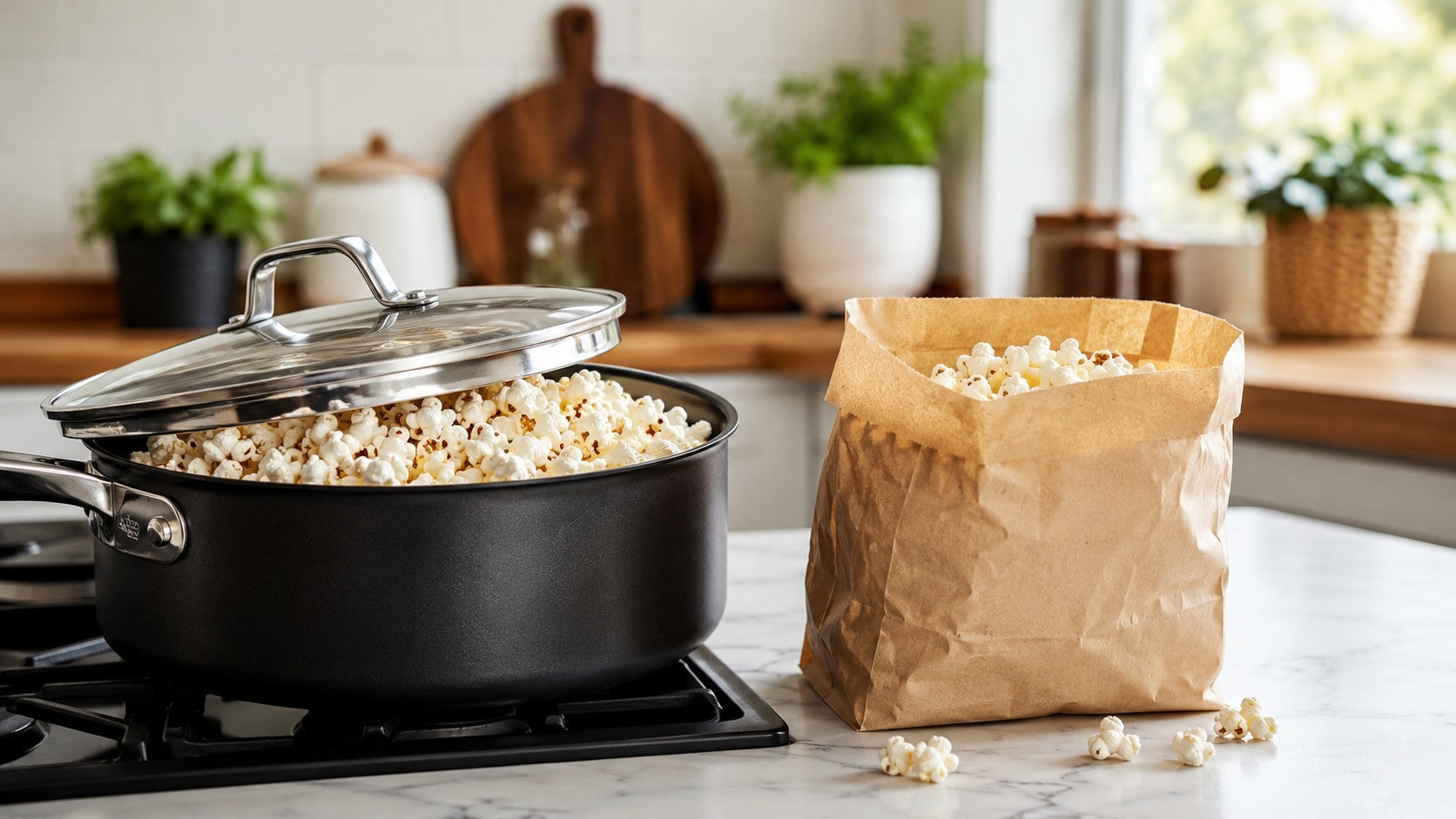
If you've ever found yourself standing in the kitchen in the evening with a bowl of kernels in hand, wondering "what now?", microwave popcorn vs. stovetop popcorn isn't just a matter of taste. It's...
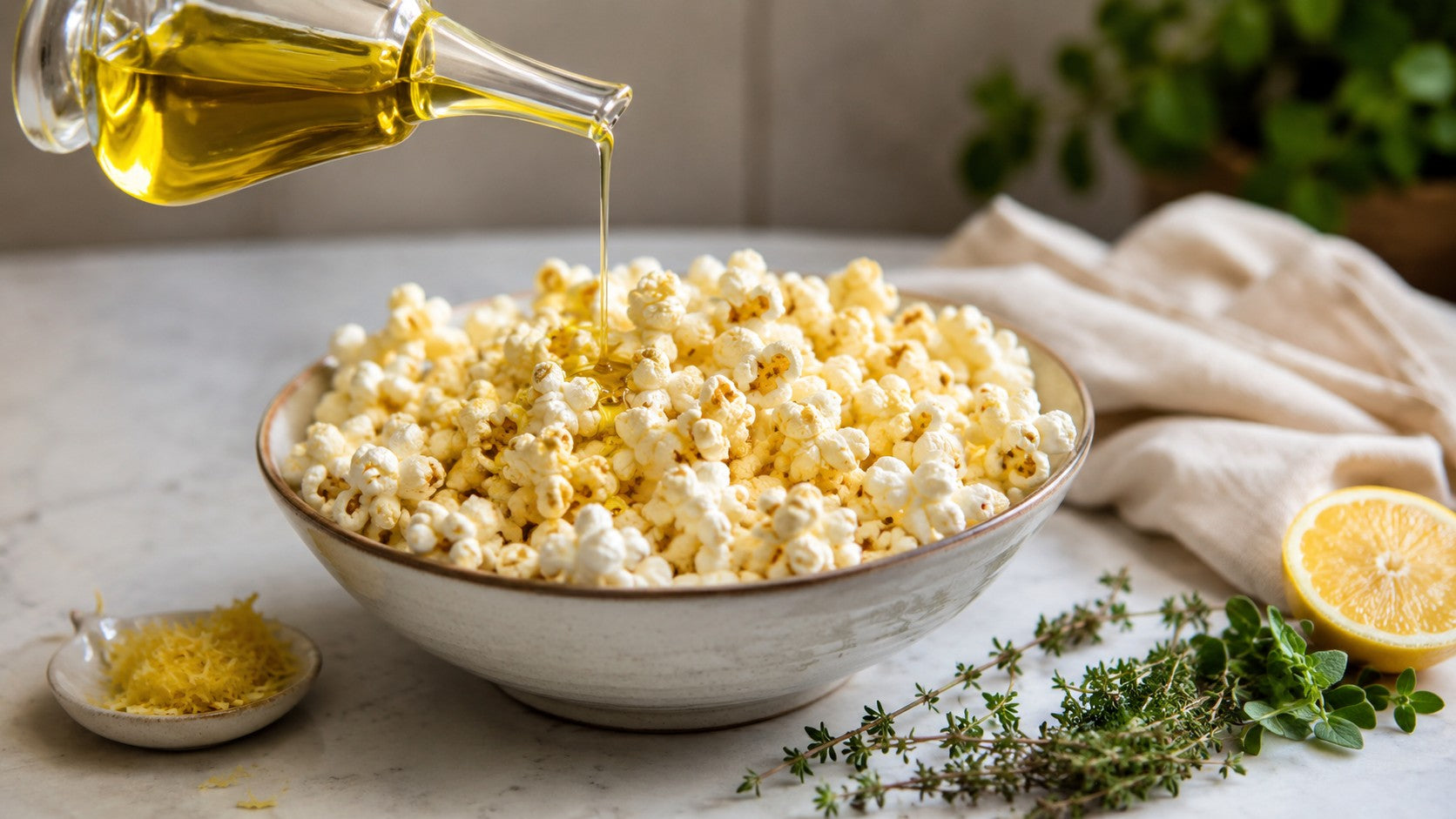
The craving for popcorn usually comes on fast, but not always with a desire for butter, grease, or a pot that needs scrubbing afterwards. This is precisely where the question of how to make popcorn...