
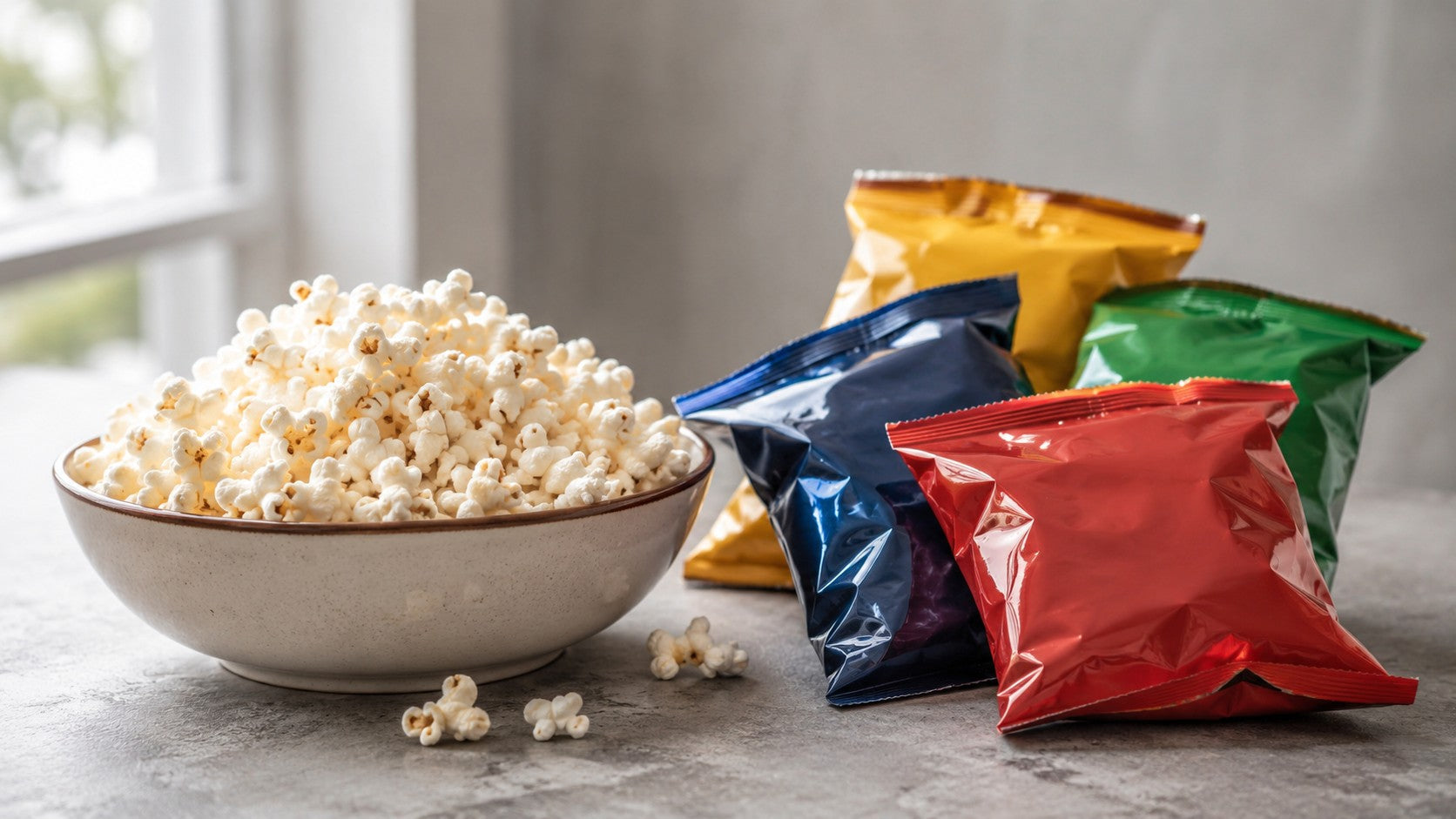
Homemade Popcorn vs. Processed Snack – Which is better?
There's a moment in the evening when everyone wants a snack, and they want it now. That's precisely when the real question arises: homemade popcorn versus a processed snack – which truly provides more peace of mind, more control, and a better feeling after the last bite? If you look beyond the packaging and immediate convenience, the difference is greater than it seems.
A processed snack is designed to be ready, stable, and very tasty from the first moment. It's convenient, no argument there. But this convenience often comes with a longer list of ingredients, more salt, more fat, and less control over what goes into the bowl. Homemade popcorn, on the other hand, starts with something very simple: kernels. From there, you decide what to add, how much to add, and even whether to add anything at all.
Homemade Popcorn vs. Processed Snack: The Difference Starts with Ingredients
When you open a processed snack, you usually get a product that has already been seasoned, processed, stabilized, and packaged to last a long time and maintain a consistent flavor. This doesn't necessarily mean every snack is a bad choice, but it does mean there's less transparency and less flexibility. Even if the packaging looks innocent, in practice, you can't change much.
With homemade popcorn, the picture is completely different. You can make it from kernels alone, without starting with oil, without dousing it in salt, and without relying on industrial mixtures. This is a significant advantage for anyone trying to reduce ultra-processed foods, maintain nutritional balance, or simply understand what they're eating.
The beauty here isn't just in what's absent, but also in what's present: control. Want it mild? Add a little salt. Want a rich flavor? You can add a precise amount of olive oil after preparation. Making it for kids? You can go for a clean, simple version. Hosting friends? Add spices, nutritional yeast, or smoked paprika. The same base, endless possibilities.
Not Just Calories: The Snack's Composition Also Matters
Many people evaluate a snack solely by its calorie count, but that's only a partial picture. What affects how you feel is also the food's composition: how much added fat, how much sodium, how many additives, and how close the food is to its natural form.
Popcorn, at its core, is a whole grain. When you make it at home from kernels, you can enjoy a simpler snack, with less unnecessary burden. A processed snack, on the other hand, can easily turn from a small snack portion into something that feels small in your hand but is heavier in terms of its composition.
Here it's important to be fair: not all homemade popcorn is automatically healthier. If you drown it in butter, add salt generously, or pour in oil without paying attention, the advantage diminishes. But the critical difference is that at home, you control the quantity. You're not accepting a decision that has already been made for you in a factory.
Homemade Popcorn vs. Processed Snack in the Convenience Test
This is usually the main argument against home preparation: who has time now to start a pot, lid, oil, mess, and smell? And rightly so. For years, the choice felt binary: either make it yourself and deal with the hassle, or buy something ready-made and compromise on ingredients.
But today, convenience no longer belongs only to processed products. With Ecobag, you pour kernels, close it, and heat it for 2-3 minutes in the microwave, without oil and without a pot, and a large part of the processed snack's advantage disappears. This is exactly where homemade popcorn transforms from a "theoretically correct" choice to a choice that fits into real life.
An active household needs easy solutions. Students need something quick between classes. Parents want a snack that can be prepared without turning the kitchen into a disaster zone. If preparation is fast, clean, and allows control over ingredients, you no longer have to choose between health and convenience.
Where You Feel the Difference in Everyday Life
The advantage of homemade popcorn isn't just measured in nutritional tables. It's felt in daily routines. Less grease on your fingers, less feeling of heaviness after the snack, fewer questions about what was actually in it, and fewer problematic packages left in the trash afterwards.
For families with children, this is especially pronounced. When prepared at home, it's easier to adjust the taste without accustoming palates to high levels of salt and seasoning. This doesn't mean every snack needs to be "healthy" to the extreme, but it does allow for a different standard, one based on simple raw ingredients rather than an industrial formula.
Even for those managing their weight or trying to eat more precisely, there's a real benefit here. Instead of eating a snack designed to be addictive and intensely flavored, you can eat something crunchy, satisfying, and easier to manage. When every addition is intentional and not a default, eating becomes more mindful.
Waste Also Plays a Role in the Decision
Many food decisions are made based on taste and convenience, but today more consumers also check what's left after they've finished eating. Here, processed snacks often have a clear disadvantage: a lot of packaging for little content, and sometimes layers and materials that don't feel particularly clean.
Homemade popcorn allows you to reduce this gap. When the starting point is kernels, and when the preparation method is based on a simpler solution without unnecessary materials, the entire experience becomes cleaner, both on the plate and in the bin. This is not a secondary issue. For many homes in Israel, sustainability is no longer a slogan but part of everyday life.
If you can make a quick snack without plastic, without aluminum, and without industrial coatings, that's a choice with practical significance. Not dramatic, not perfect, but smarter. Exactly what many people are looking for today.
When a Processed Snack Can Still Be Suitable
The truth must be told: there are situations where a processed snack is simply the available solution. A trip, a long drive, an office without convenient access to preparation, or moments when you have no energy for anything. Life doesn't operate according to a dietary ideal, and that's okay.
But if there's an easy option at home to make fresh popcorn in a few minutes, the processed snack doesn't have to be the default. It can remain a temporary solution, not a permanent habit. Once you change the starting point, many dietary decisions improve on their own without a struggle.
And perhaps this is the most important message: you don't have to be perfect to choose better. You don't have to turn every evening into a project, and you don't have to give up the fun of snacking. It's simply better to choose a cleaner base when possible.
How to Make Homemade Popcorn the Default
The best way to eat better is not to rely on willpower, but to make the right choice easier. If kernels are available at home and the preparation method is quick, homemade popcorn becomes a natural solution. Not the "healthy option," but a snack that simply works.
For this to work long-term, it's good to keep it simple. Start with a clean version, taste it, and then play with seasonings. A little salt, a little quality oil if desired, or dry additions that add character without being overwhelming. Children like it mild, adults sometimes prefer spicy or smoky, and you can make one base and divide it into different bowls.
How Ecobag Takes the Processed Snack Out of the Equation
Ecobag is an Israeli brand that created precisely the missing link: a paper bag with a unique closure, without plastic coating and without PFAS, into which you pour your own kernels. Pour, close, pop. No pot, no oil, and no dishes in the sink.
For those who want a cinema-style result, only cleaner, add mushroom-type corn kernels that pop large, round, and crispy.
- Ready in 2-3 minutes, as fast as opening a snack bag
- Ingredient list is one word long: kernels
- Salt and seasoning remain under your control
- Less packaging and less mess in the kitchen
You can start with an Ecobag set for natural homemade popcorn and add mushroom-type corn kernels.
So What's Really Better?
If the only test is what's more ready, the processed snack has an advantage. But if you consider the full picture—ingredients, control, how you feel after eating, suitability for children, kitchen cleanliness, and the waste left behind—homemade popcorn offers a stronger answer.
It's not perfect in every situation, and it still depends on what you add to it. But it starts from a cleaner, more flexible, and smarter point. When so many products come laden with things we didn't ask for, there's something refreshing about a snack that starts with a simple kernel and ends exactly how you want it.
In the end, the best choice is the one you can live with even on a busy day: one that doesn't demand sacrificing taste, doesn't create a mess, and gives you a sense of control over what goes into the bowl and what's left behind. Order an Ecobag set and let homemade popcorn be your default.
Read more
There's that moment at home: the kids want a snack, there's a movie to start, or you just crave something warm, crunchy, and satisfying. This is exactly where homemade popcorn becomes the truly sma...
Popcorn seems like an innocent snack, until you start reading what really goes into the bag. Between high amounts of oil, excessive salt, flavorings, and packaging whose composition isn't always cl...