
A Guide to Choosing Healthy Popcorn at Home
Popcorn seems like an innocent snack, until you start reading what really goes into the bag. Between high amounts of oil, excessive salt, flavorings, and packaging whose composition isn't always clear, a guide to choosing healthy popcorn actually starts with a simple question: do you want to control only the taste, or also what goes into your body and home?
Popcorn can be an excellent snack. It's based on whole corn kernels, relatively filling, easy to prepare, and suitable for children, students, entertaining, and movie night without feeling like you've gone off track. But as with many convenient products, the difference between a good choice and a less good choice lies in the small details: not just in calories, but also in the amount of oil, the sodium level, the ingredient list, and how it's prepared.
Guide to choosing healthy popcorn: What to check first
The first thing to check is the ingredient list. If you're buying ready-made popcorn or a mix for preparation, look for a short, clear, and understandable list. Corn kernels, maybe a little oil, maybe a little salt – that's the direction. The longer the list becomes with flavorings, stabilizers, fragrances, and additives you wouldn't put in your kitchen yourself, the less control you have.
This doesn't mean every additive is necessarily a problem, but it does mean it's worth asking why it's there. If the product needs a lot of help to be tasty, it's probably constructed differently from simple homemade popcorn that you season yourself.
The next step is to understand where the fat comes from. Popcorn itself doesn't have to be heavy or greasy. In practice, many ready-made products rely on a generous addition of oil to provide flavor, texture, and a sense of indulgence. If a lighter snack is important to you, check not only if there's oil, but how much there actually is per serving.
Salt also deserves attention. It's very easy to overdo it with popcorn, because it's perceived as a "light" snack. In practice, aggressive seasoning can turn it into a high-sodium product without you noticing. Those who prepare it themselves can start with a little and adjust to taste. This is not only a healthier choice, but also a tastier one, because not every bite needs to taste like seasoning powder.
Healthy doesn't mean tasteless
One of the common mistakes is to think that healthy popcorn has to be dry, bland, or "diet" in the disappointing sense of the word. In fact, good popcorn is an excellent example of simple food that works brilliantly when you let the raw material lead. Quality kernels, proper preparation, and precise seasoning yield a crispy, fragrant, and satisfying result, without drowning the snack in fat or salt.
This is where the cooking method comes in. If you're making popcorn in a pot, you have good control, but also more fuss, more dishes, and more chance of adding "just a little more" oil. If you choose a pre-made microwave bag, it's very convenient to start, but you usually also get a recipe that's already decided for you, including the type of fat, the amount of salt, and everything else.
The smart solution is in the middle: prepare kernels only in the microwave, in a bowl or a dedicated paper bag, and then season to your liking. This is precisely why we developed Ecopop bags: paper without plastic coating, without PFAS, and without the need for oil, so you maintain convenience and don't give up control. This is the difference between convenience that keeps you away from the kitchen and convenience that works for you.
How to read a label without getting confused
You don't have to be a nutritionist to make the right choice. It's enough to understand three basic data points: the number of ingredients, the amount of fat, and the amount of sodium. If the product shows particularly high values relative to a reasonable snack serving, that's a sign to stop and check.
It's also worth paying attention to the serving size definition. Sometimes the values seem reasonable, but the serving is very small and doesn't reflect what you actually eat in front of a movie or in the living room with the kids. If you actually eat two or three servings, you need to look at the full picture.
Another important point is flavorings. "Butter" flavor, for example, doesn't always mean there's butter in it, and "natural" flavor doesn't always mean the product is simple and clean. The goal isn't to be alarmed by every term, but to understand that the closer the product is to the original kernel, the more transparency and fewer surprises you'll have.
Packaging is part of the choice
When talking about a guide to choosing healthy popcorn, most people stop at the ingredients. But packaging also matters. If you use a product regularly, it's worth asking what the packaging is made of, what happens to it when heated, and whether it adds another layer of materials you didn't really want in your kitchen.
For many families and conscious consumers, health and environment are no longer separate. A snack that seems convenient but comes with layers of unnecessary materials, or with waste that is difficult to deal with, is less suitable for a life they want to simplify. Cleaner, simpler packaging without unnecessary industrial materials is not a marketing bonus; it's part of daily use.
If you make popcorn often, true convenience is also measured by what happens after preparation: less mess, fewer dishes, fewer greasy residues. A quick snack should feel light both before and after.
Which popcorn is right for whom
If you're a parent, the main consideration is probably a combination of speed, simplicity, and control. You want something you can prepare quickly, without a pot on the stove, and without serving your children a snack loaded with unclear ingredients. In this case, popcorn from kernels with homemade seasoning is usually the more precise choice.
If you're watching your weight or simply prefer a cleaner snack, controlling the amount of oil and salt is the big advantage. Instead of getting a pre-set seasoning, you can prepare a neutral base and add a little olive oil, fine salt, or dry spices in a precise amount.
If you're entertaining or like to play with flavors, simple popcorn gives you much more freedom. You can go for smoked paprika, dry garlic, nutritional yeast, cinnamon, za'atar, or even a slightly sweet version. When the base is clean, every addition feels clearer and isn't lost in a dense industrial product.
How to choose kernels
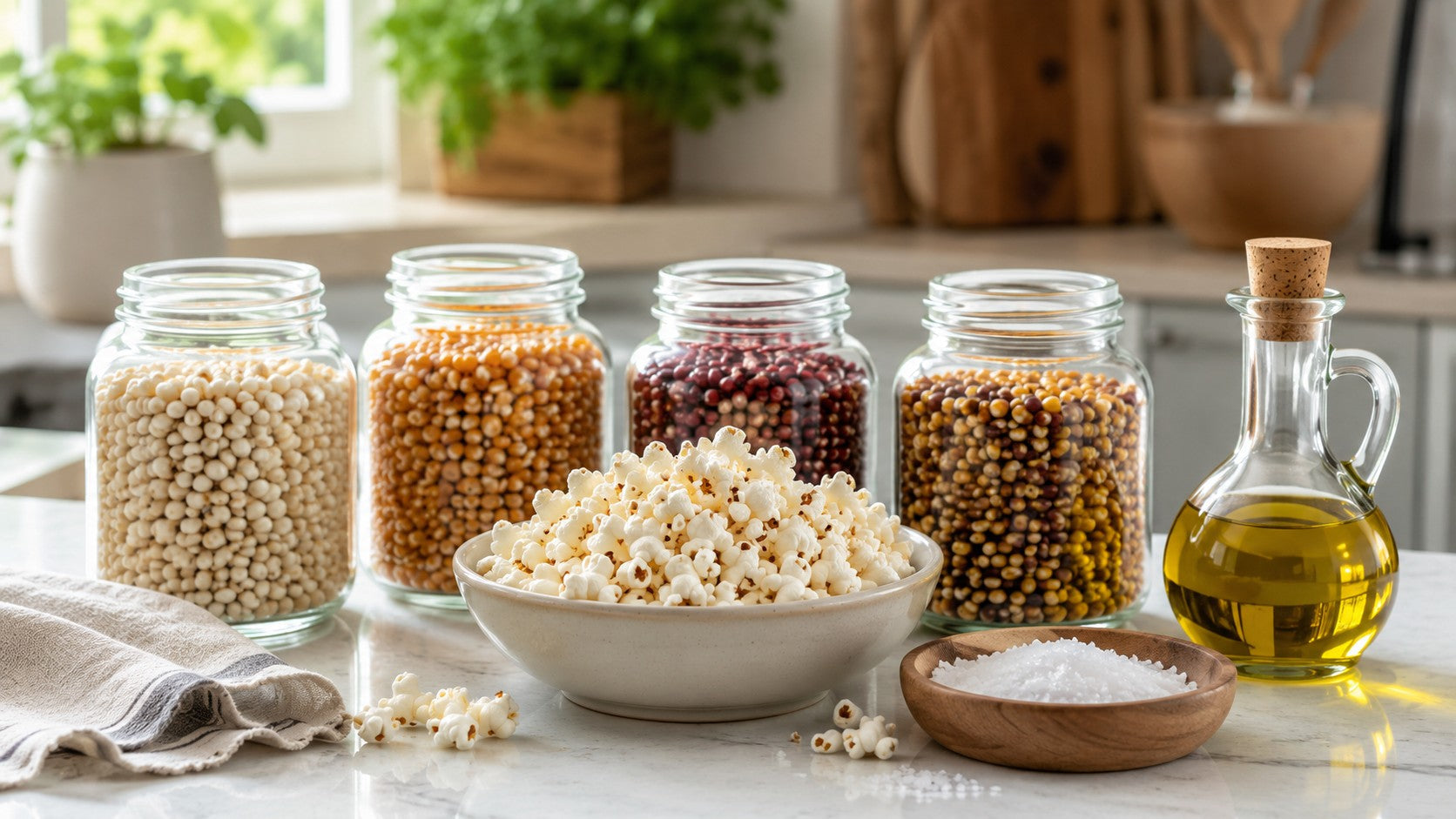
The kernels themselves also play a role in the result. Fresh kernels stored in a dry place will pop at a higher rate and yield a crispier texture. Beyond that, there's a difference between varieties: the mushroom variety pops into a round, large shape that holds seasoning well, while other varieties yield a more winged and fragile shape.
If you make popcorn a few times a week, it's worth keeping quality kernels in a sealed jar. The difference in taste and texture is noticeable from the first bowl.
Common mistakes in choosing
The first mistake is to rely only on labels like "light," "baked," or "thin." These words don't tell the whole story. What matters is what's really inside and how much control you retain.
The second mistake is to think that homemade popcorn is always healthier, regardless of how it's prepared. Even at home, you can make it very oily and salty. The advantage of homemade preparation is not automatic; it depends on the amount of oil, the type of seasoning, and the preparation method.
The third mistake is to neglect the convenience factor. When a healthy solution requires too much time, dishes, and mess, it's hard to stick with it. Therefore, the best choice is usually one that manages to be both cleaner and simpler to use. If it fits your lifestyle, there's a high chance you'll actually use it.
How to build a better habit
Instead of looking for the "perfect popcorn," it's better to build a routine that works: keep good kernels at home, choose a simple preparation solution, and decide in advance how you like to season it. Once the action becomes easy, popcorn transforms from a random snack into a regular choice that's pleasant to return to.
You can also think of popcorn as a base, not as a closed product. Just like a salad or yogurt, you start with a simple raw material and end with a taste that suits you. This changes the entire experience: less automatic consumption and more conscious choice.
The recommended home kit: Ecopop bag and mushroom kernels
If you want to translate this entire guide into one shopping list, it's short. Ecopop, an Israeli brand, produces a paper bag with a unique seal that makes popcorn in the microwave in 2-3 minutes from kernels you choose, without oil and without coatings.
Alongside it, mushroom variety corn kernels provide the texture most people are looking for: large, round, and crispy popcorn that holds seasoning without crumbling. Together, this is the set that fulfills both requirements of the guide, clean ingredients and real convenience.
- Ingredient list with one word: kernels
- No oil, no butter, no PFAS, and no plastic coating
- Full control over salt and seasoning, after preparation
- A pack of bags that lasts for many evenings, with no dishes to wash
You can order the Ecopop natural homemade popcorn bag pack along with mushroom variety corn kernels.
Healthy popcorn doesn't start with a big promise on the packaging. It starts with a kernel, continues with a simple choice, and ends with a bite that feels lighter, tastier, and more right for your home. If you want to start from the right place, grab an Ecopop bag pack and see how simple it is.
Read more
There's a moment in the evening when everyone wants a snack, and they want it now. That's precisely when the real question arises: homemade popcorn versus a processed snack – which truly provides m...
The first pop always sounds like a promise for an easy evening. The problem starts a second later: a pot that needs washing, oil that's hard to measure, or a ready-made microwave bag that doesn't r...