
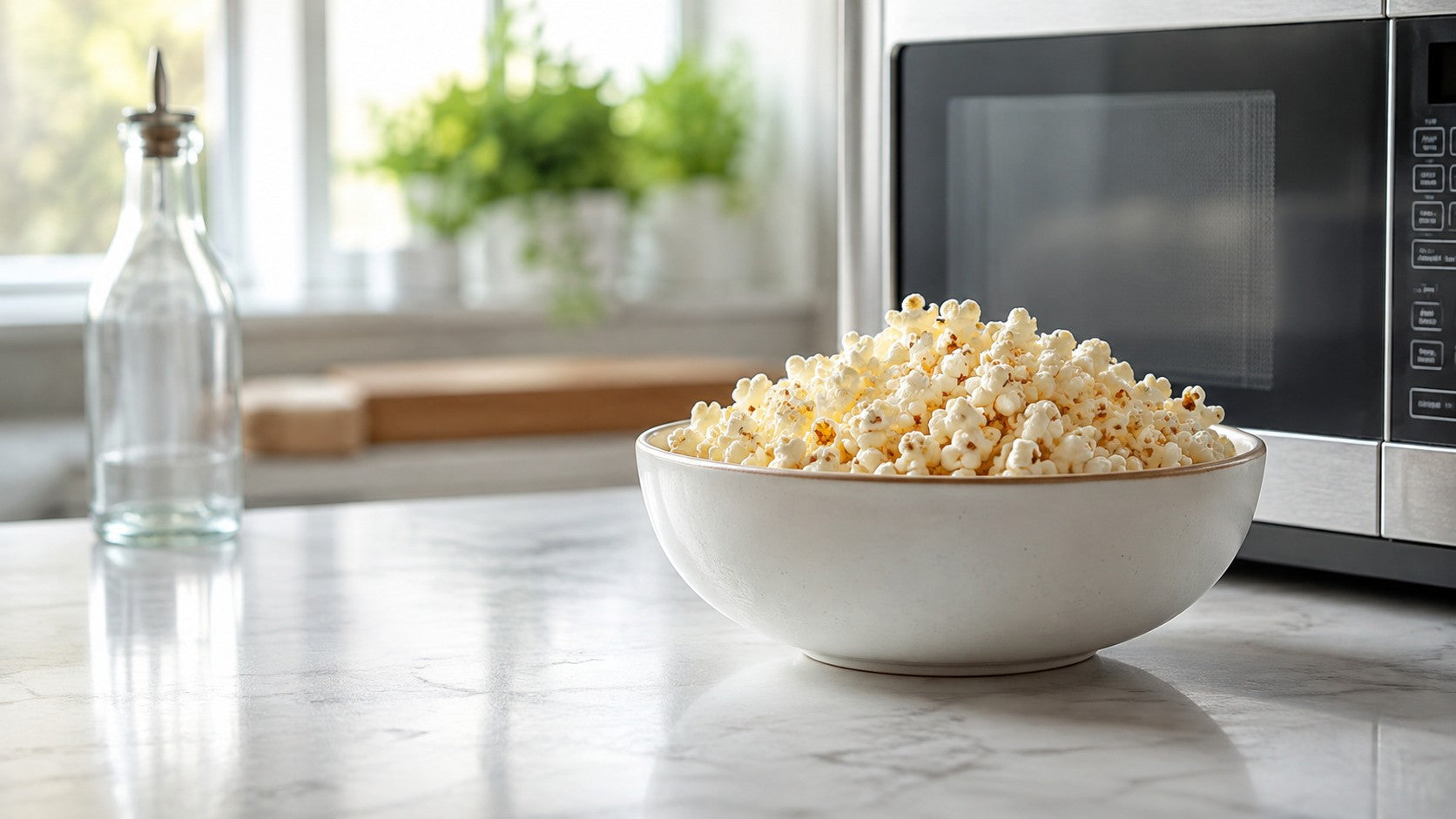
Microwave Popcorn Without Oil – Here's How to Do It Right
There's a moment in the evening when you crave a snack right now, not in half an hour, not after dealing with a pot, oil, stove, and a sink full of dishes. This is precisely where oil-free microwave popcorn goes from being a nice idea to a working solution. It provides what most of us are looking for: a hot, quick, crispy snack, with full control over what goes into it, and without all the fat, additives, and unnecessary packaging that sometimes come with ready-made microwave bags.
The big advantage isn't just about calories. It's also about convenience, cleanliness, and control. When you make popcorn from just kernels, you can decide how much salt, if any, to add, what seasoning to use, and whether you want to leave it completely natural or give it a small twist. Instead of getting a pre-packaged industrial product, you get a simpler preparation experience that fits real life.
Why oil-free microwave popcorn feels like a real upgrade
Popcorn has been considered one of the smarter snacks for years, as long as it's not overladen. The moment it comes with a lot of oil, salt, flavorings, and packaging that doesn't always feel clean or friendly, the picture changes. Preparing it without oil brings it back to what it's meant to be: corn kernels that pop into a light, pleasant, and satisfying snack.
Beyond the nutritional aspect, there's also a very practical matter. Preparing it in a pot requires attention, stirring, a lid, cleaning, and sometimes an oil smell that lingers in the kitchen. Ready-made bags are quick, but the price is usually less control and more unnecessary ingredients. That's why more and more people are looking for a third way: as convenient as a microwave, as clean as homemade, and without compromising on what goes into the body.
How to make oil-free microwave popcorn
The method itself is simple, but to get a good result, you need to understand two or three small principles. Not every container is suitable, not every quantity works the same, and heating time also has great significance.
The base is dry popcorn kernels. Do not add oil before heating. Place the kernels in a dedicated paper bag or a microwave-safe container that allows space for steam and expansion. The quantity should be reasonable, not too little, but not filled to the brim either. In most cases, a few tablespoons will be enough for a nice serving without overloading.
This is exactly what Ecopop's paper bag does: it's designed for completely dry preparation, without a drop of oil, and the unique closure keeps it sealed while the kernels pop.
From there, microwave at an appropriate power and listen. This is the easiest part to miss. Don't wait for the popping to stop completely, because then the already opened kernels will start to burn. The moment there is a clear slowdown between pops, stop. Sometimes it will take a minute and a half, sometimes two and a half, depending on the appliance, quantity, and type of kernel.
After heating, let the bag or container rest for a few seconds. The steam is hot, and the popcorn continues to settle. Only then open, add seasoning if desired, shake lightly, and serve.
What affects the result
If you've ever had popcorn that was too dry, burnt, or with many unpopped kernels, it doesn't mean the method isn't good. Usually, it's just a small adjustment that's missing.
The quality of the kernels is important. Old kernels or those stored poorly lose internal moisture, and then they simply don't pop properly. The microwave itself also changes the picture; some appliances are very powerful, and others work less uniformly. Therefore, the first time, it's better to check the time closely and not automatically follow a fixed number.
The type of bag or container also plays a role. You need a solution that allows the kernels to heat well, the popcorn to gain volume, and the steam to escape without creating a mess. When using a dedicated and clean solution, the whole process feels shorter, more organized, and especially more predictable.
The common mistake: thinking that oil-free means flavor-free
This is probably the main reason people hesitate. It seems that oil-free popcorn will be bland, dry, or less enjoyable. In reality, it depends on what you do after preparation, not just what you don't put in beforehand.
When you don't start with a heavy layer of oil, the taste of the corn itself is more prominent. It's toasted, warm, and surprisingly good. If you want, you can leave it like that, especially for those who like a clean and simple snack. And if you want more character, there's plenty of room to play.
A little fine salt may be enough. You can add smoked paprika, garlic powder, nutritional yeast, cinnamon with a touch of sugar, za'atar, or a delicate spicy blend. Those who still prefer a little fat don't have to give it up completely; you can add a very small amount after preparation and control the quantity instead of getting it pre-determined without choice.
Smart seasoning starts with a small amount
Here it's worth pausing on an important point: over-seasoning spoils faster than under-seasoning. If you add too much powder, the popcorn can become heavy or uneven. It's better to start small, shake, taste, and then decide if you need more.
This is precisely one of the reasons why homemade preparation works so well for families, students, and those who like to entertain. You can prepare one base and divide it into several different flavors without an extra pot and without much effort.
Healthier, but still need to be realistic
Oil-free microwave popcorn is a better choice for many people, but it shouldn't be turned into a magic food. If you load it with large amounts of salt, sugar, or fatty sauces after preparation, the benefit diminishes. On the other hand, if you maintain measured seasoning, you get a snack that feels indulgent without feeling heavy.
It's also an excellent solution for those trying to reduce automatic consumption of processed snacks. The very fact that you start with kernels and not a pre-made product changes your relationship with snacking. There's more awareness, more choice, and less of a feeling of "whatever's in the package, we'll eat it."
What about sustainability?
Anyone trying to live a little cleaner knows the dilemma: convenience usually comes with another layer of waste. Precisely because of this, simpler solutions for making popcorn at home feel so accurate for this time. If you can make a hot, quick snack without plastic, without aluminum, and without unnecessary layers of industrial materials, it's not only more pleasant, but it also aligns better with a conscious kitchen.
The point here is not perfection. No one needs to run a laboratory around every snack. But when you can choose a solution that generates less mess, less waste, and more transparency, it's a choice that's easy to adopt again and again. Therefore, it's not surprising that more consumers today are looking for a way to make popcorn at home without hassle and without carrying a package full of question marks.
Who is it best for?
The simple truth is almost everyone, but for different reasons. Families love the ease and the ability to control the amount of salt for children. Students and young adults want something cheap, quick, and satisfying that doesn't require an equipped kitchen. Those who maintain a diet appreciate the option to avoid unnecessary oil. And those who also think about the environment are looking for a solution that puts less strain on the household waste bin.
Hosts also have a surprising advantage here. Fresh, hot, and personalized popcorn is a snack that feels more invested than it requires. You can serve bowls with different flavors, bring out another round in minutes, and keep the table relatively clean without all the fuss of pans and splatter.
When you choose a good solution, everything becomes simpler
If there's something that turns a small habit into a regular habit, it's not just intention but also simplicity. The moment preparation isn't messy, complicated, or requires taste compromises, it's much easier to choose it again tomorrow evening.
The beauty is that you don't have to be extreme health enthusiasts to enjoy it. It's enough to want a snack that's a little cleaner, a little more controlled, and a little less industrialized. From there, it starts working on its own.
How to make oil-free popcorn in an Ecopop bag
We founded Ecopop precisely for this dry preparation. Our bag is made of paper without plastic coating and without PFAS, so it doesn't need oil to work. Pour in your own kernels, seal with the unique closure, 2-3 minutes in the microwave, and empty into a bowl.
No oil, no pre-made seasoning, and no pot. The popcorn pops purely from heat, and you add salt or spices only at the end, exactly to your desired amount.
- Completely dry preparation, without a drop of oil
- Paper without plastic coating and without PFAS
- 2-3 minutes in the microwave, no pot, no supervision, and no dishes to wash
- Comes in a multipack, so you always have a bag ready for the next evening
You can order the Ecopop bags multipack for natural homemade popcorn, and for those who want an extra crispy result, also mushroom variety corn kernels that pop large and round.
Oil-free microwave popcorn: How to make it a good habit
For it to take its place in the kitchen, it's worth thinking of it not as a punitive substitute for snacks, but as a good option in itself. When prepared correctly, it doesn't feel like a sacrifice. On the contrary, it feels like an upgrade: less heavy, less messy, more flexible, and with enough room for your personal taste.
Perhaps this is the most important point in the whole story. You don't have to choose between health and convenience, or between taste and environmental responsibility. Sometimes all you need is a simple solution that brings order, and the Ecopop bags multipack makes the most everyday snack a little smarter.
Read more
If popcorn is your go-to snack for movie night, homework sessions, or a small hunger pang between meals, the question isn't whether to make it, but how to make healthy popcorn at home without turni...
If for you too, popcorn comes down to two options – a pot that dirties the kitchen or a ready-made microwave bag with an ingredient list you'd rather not read – it's time to talk about how to make ...