
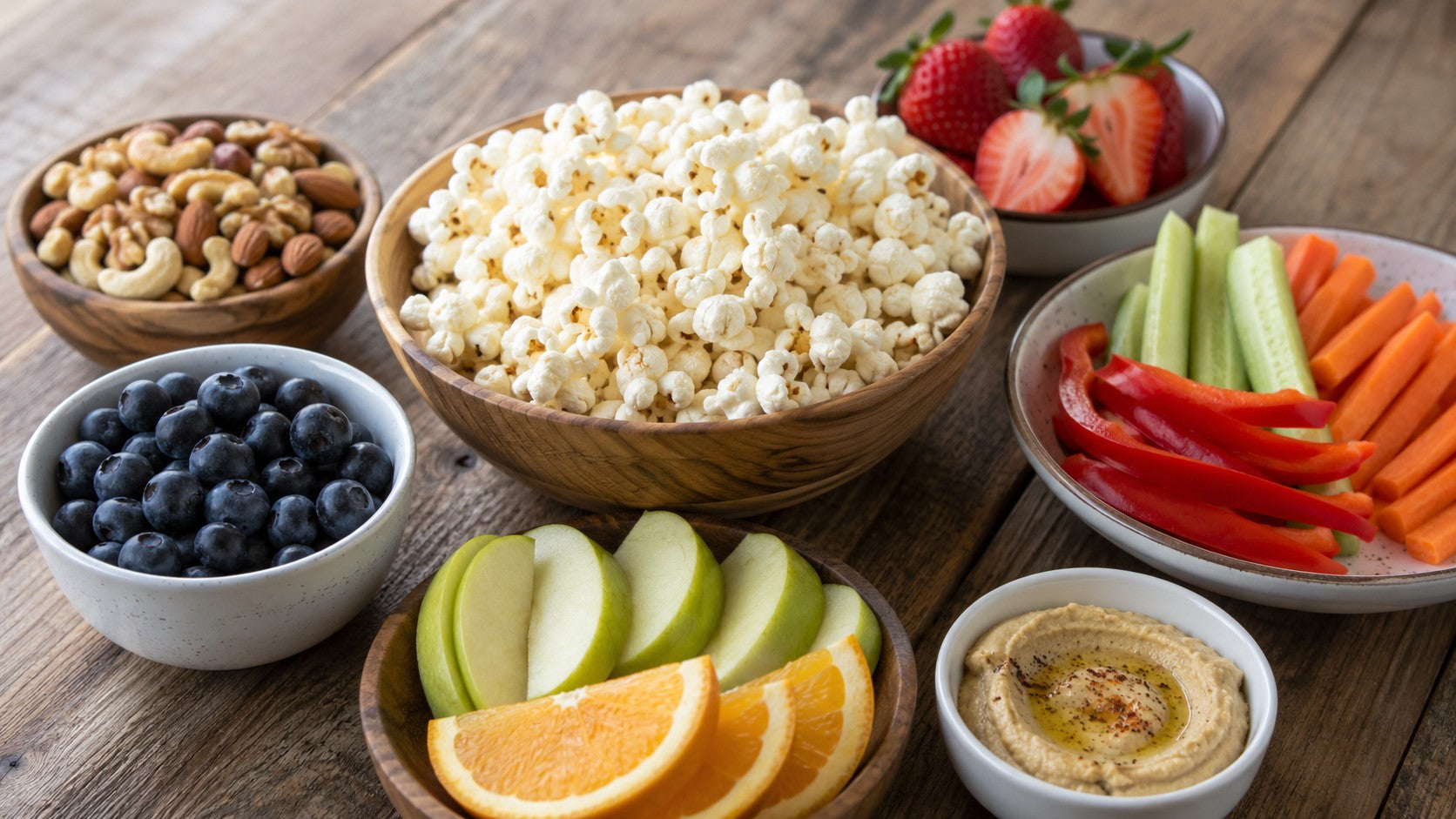
A Guide to Choosing a Truly Healthy Homemade Snack
It's four in the afternoon, the kids are hungry, you're between meetings and errands, and your hand is already reaching for a pre-made snack. This is precisely where a guide to choosing a healthy homemade snack goes from being a nice-to-have to a game-changing idea. Because a good snack shouldn't be a compromise between taste, convenience, and health. It can be quick, satisfying, made with cleaner ingredients, and also one that doesn't leave you feeling heavy or the kitchen messy.
The problem is that not every snack that feels "homemade" is a smart choice. Even at home, it's very easy to get carried away with quantities of oil, salt, sugar, or processed products that seem innocent. The right choice doesn't start with the question "what tastes good," but with a simpler question: what exactly do I have control over?
A guide to choosing a healthy homemade snack begins with control
The first principle is control over ingredients. When you prepare a snack at home, the greatest advantage is not just saving time or the homey feeling, but the ability to decide what goes in and what stays out. Less oil, less salt, no unnecessary additives, and no ingredients you don't need.
This sounds basic, but this is exactly where many daily choices fall short. There are snacks that seem light, but in practice rely on ready-made seasoning, high-sodium sauces, or a processed base. Therefore, if you want to choose correctly, look for a solution where the raw material is clear, short, and familiar. If you can start with one or two ingredients and add only what's necessary, you're on the right track.
Popcorn is an excellent example of this. Not the industrial version with a long list of ingredients, but popcorn that starts with just kernels. The moment you determine the amount of oil, choose your own seasoning, and skip coatings and additives, it suddenly becomes a simple, satisfying, and very flexible snack.
What makes a homemade snack healthier?
A healthy homemade snack is not measured solely by the calorie count. It is also measured by the quality of the ingredients, the level of processing, your ability to feel full from it, and whether you want to eat more and more of it without noticing.
The first thing to check is how close the product or dish is to its original form. The more a snack is based on a simple raw material, the easier it usually is to understand what you're eating. The second thing is the intensity of the seasoning. Often, the food itself is not the problem, but what is added to it. Even a snack considered "healthy" can become less successful if it's overloaded with salt, butter, sugar, or flavor powders.
The third point is satiety. A good snack should satisfy, not just keep your mouth busy. If after ten minutes you're looking for something to eat again, chances are the choice didn't serve you well. Sometimes it's better to have a simple snack, with good volume and a clean taste, that provides a complete eating experience without being heavy.
How to choose according to the situation, not just the title
There isn't one snack that fits every moment. What's suitable for a movie night isn't necessarily suitable for a lunchbox, and what's good after a workout won't always work with your morning coffee. Smart choices depend on the context.
If you're looking for something for the kids, it's especially important to pay attention to simplicity. A pleasant taste, a familiar texture, and quick preparation will work better than any "sophisticated" snack that no one will want to eat. If the goal is a quick solution between tasks, the great value is convenience: how easy it is to prepare, how easy it is to clean afterward, and whether you have control over the quantity.
Conversely, if it's a snack for entertaining or an evening at home, you can also introduce an element of experience. Here, a healthy homemade snack can become something truly enjoyable, especially when it allows for playing with flavors without turning the kitchen into a project.
The signs that usually work in your favor
There are some simple signs that can help identify a good choice. The first is a short and clear ingredient list. The second is preparation that doesn't require much industrial intervention: fewer powders, fewer coatings, fewer flavor enhancers. The third is the ability to adapt the snack to you: mild or seasoned, without additives or with a little quality oil, for children or adults.
When all these come together, it's easier to build a stable habit. Not one that feels like dietary discipline, but one that simply works in real life.
Homemade popcorn: the first choice on the list
Over the years, homemade popcorn has had two unsuccessful extremes. On the one hand, cooking it in a pot, which can be tasty but also messy, requires attention, and doesn't always end well. On the other hand, fast industrial solutions that come with too much oil, too much salt, and too many ingredients you wouldn't choose yourself.
The advantage of properly made homemade popcorn is its simplicity. Kernels, a short heating time, and seasoning according to what suits you. It's a snack with generous volume, a feeling of indulgence, and a very high level of control. It can be almost completely natural, or take on character with a little olive oil, paprika, cinnamon, za'atar, or nutritional yeast, depending on taste and purpose.
In terms of routine, it's also a smart choice. It's quick enough for a busy day, fun enough for kids, and flexible enough for those trying to reduce ultra-processed foods. We at Ecopop designed our microwave paper bag precisely for this need: popcorn from your own kernels, without plastic, without aluminum, without oil, and with full control over what goes into the bowl.
When popcorn is less suitable
Like any snack, there's a matter of moderation and additions here too. If the popcorn is swimming in butter or covered with a thick layer of salt and industrial seasoning, the health benefit quickly erodes. Additionally, those looking for a snack with more protein or one that replaces a small meal might need to combine something else with it.
In other words, popcorn is not a magic solution. It's simply a good example of a snack that can be lighter, tastier, and more precise when the base is kept clean.
Ask yourself three questions before every choice
Instead of chasing grand definitions of "superfood" or "perfect snack," it's better to pause for a moment and ask three short questions.
The first is, do I know exactly what's in this? If the answer is vague, the choice is probably not ideal. The second is, can I control the amount of salt, oil, and seasoning? The more positive the answer, the closer the choice is to what you want to bring into your home. The third question is, is this suitable for my life right now: for quick preparation, easy cleaning, and for whoever is actually going to eat it.
These questions sound simple, but they cut through a lot of marketing noise. They help distinguish between a snack that looks good on the packaging or on the counter, and a snack that works for you in everyday life.
Not just healthy, but also convenient, clean, and practical for your routine
Many people know what they should eat, but get stuck at the execution stage. If the preparation is complicated, if there are too many dishes to wash, or if it requires time you don't have, even the healthiest choice will remain a good intention.
Therefore, convenience is not a bonus. It is part of health itself. Because what is easy to prepare is also easy to maintain. What doesn't create a mess will re-enter your routine. And what allows you to choose clean ingredients without getting complicated increases the chances that you will eat well even on a busy day.
This is especially true in active households. Families, students, those who work from home or run between tasks, all need simple solutions. A healthy homemade snack needs to respond to life as it is, not to an ideal version of it.
The snack we recommend starting with
If we had to choose one snack that meets all the criteria above, it would be popcorn made from kernels in a paper bag in the microwave. The ingredient list is as short as possible: corn kernels. Everything else is your decision, after the popcorn is already in the bowl.
- Ready in 2-3 minutes, without a pot and without constant supervision.
- Paper only: no plastic coating and no PFAS.
- No oil in preparation, and with full control over salt and seasoning.
- No dishes to wash, and the kitchen stays clean.
You can start with the Ecopop natural homemade popcorn bag pack, and add mushroom variety corn kernels for a crispier texture and larger volume.
The real test: will you want to choose it again tomorrow?
In the end, the right choice isn't the one that looks most impressive on paper. It's the one you'll want to return to. A healthy homemade snack is one that feels good during and after eating, easily fits into your routine, and gives you a sense of control instead of a feeling of compromise.
If you're wondering where to start, start simple. Clear raw materials, quick preparation, seasoning you choose yourself, and a solution that doesn't bring more than necessary into your home. Sometimes that's all the difference between a snack that's just okay, and a small habit that does you good day after day. And if you want to do it today, the Ecopop bag pack is the shortest way.
Read more
The Easy Way to Make Healthier, Fresher Homemade PopcornPopcorn is one of the most beloved snacks at home, at the movies, on movie nights, when entertaining, and even as a light snack during the da...
It's five in the afternoon, the kids are hungry, you're bouncing between Zoom calls and tidying the house, and nobody wants to start cooking. This is precisely when the question arises: how to make...