
A Guide to Choosing the Right Popcorn Kernels for Homemade Popcorn
The difference between popcorn that comes out crunchy, airy, and addictive, and a bowl with half burnt kernels and half unpopped ones, starts long before the microwave or the pot. A guide to choosing kernels for homemade popcorn is essentially a guide to controlling the outcome: the taste, the texture, the amount of waste, and how much oil and salt go into your snack.
When chosen correctly, everything becomes simpler. Fewer guesses, less mess, less disappointment. And if you're already making popcorn at home to eat cleaner and know exactly what goes into the bowl, there's no reason to compromise on the kernels themselves.
Why the kernel is more important than it seems
Popcorn is not just small corn. It's a special variety whose structure allows the trapped moisture inside to turn into steam, build pressure, and then burst the hull. That's why not every kernel will yield the same result, even if the preparation method is identical.
Two people can prepare it in the same microwave, with the same amount of seasoning, and get a completely different result. The reason will usually be the quality of the kernels: the level of freshness, moisture content, uniformity in size, and even how they were stored before reaching the kitchen.
Guide to choosing kernels for homemade popcorn: what to check first
The first thing to check is that the kernels are intended for popcorn and not for cooking or roasting corn. This sounds obvious, but the packaging doesn't always tell you enough. Look for clear labeling, a relatively uniform appearance, and hard, dry kernels without many broken pieces.
Then comes freshness. A popcorn kernel needs a certain amount of internal moisture to pop well. If it's old or stored incorrectly, the moisture is compromised, and the result will be more unpopped kernels. If you open a package and see powder, many broken pieces, or a slightly musty smell, that's not a good start.
Uniformity is also important. When there's a mix of very small and very large kernels, the popping time is less consistent. The small ones might burn before the large ones pop. For those looking for quick and clean preparation, especially in the microwave, uniformity is a real advantage.
The different varieties and what it means for your bowl
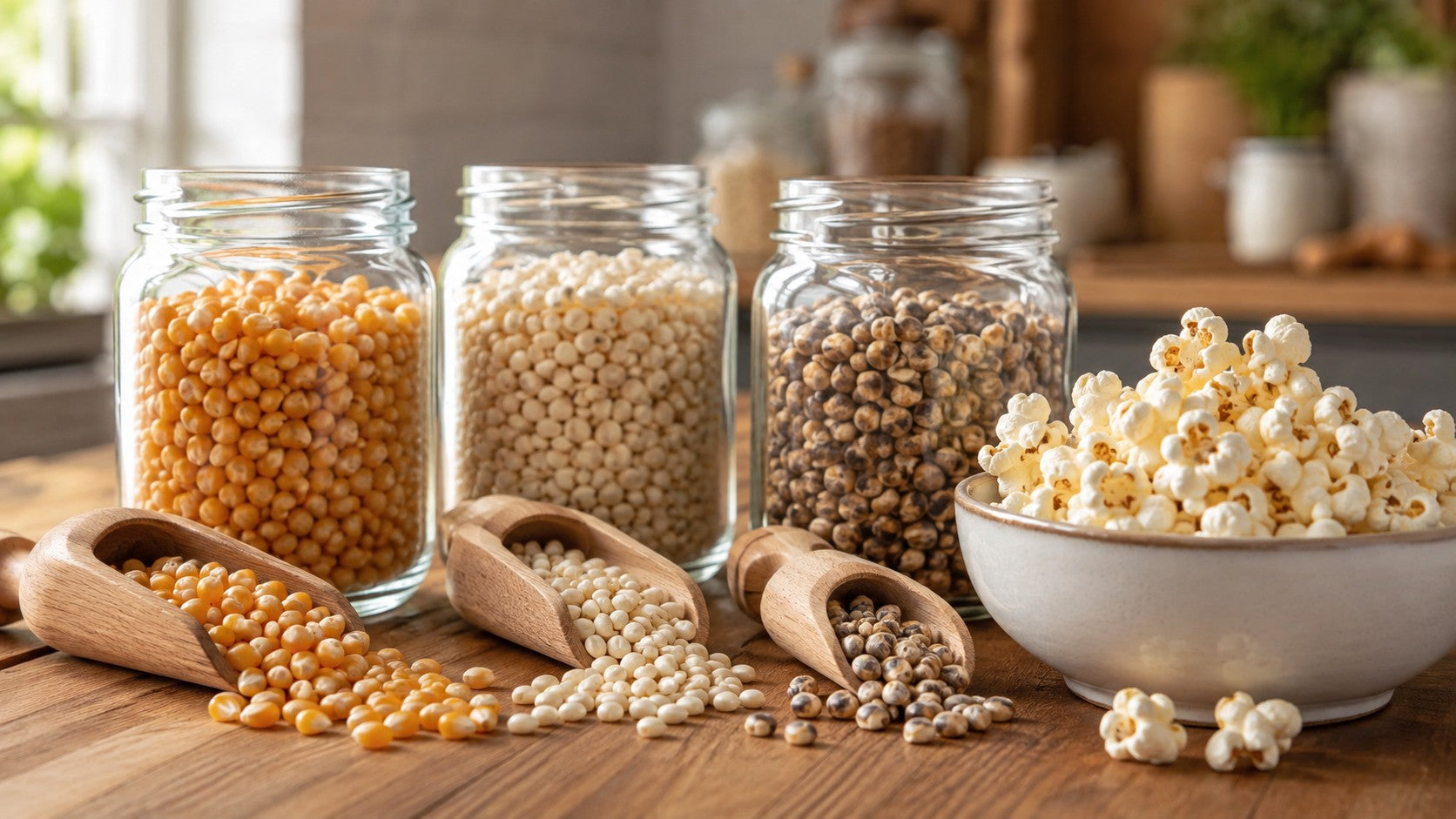
There are two common styles of popcorn, even if you don't always see them labeled as such on the packaging. One yields rounder, softer popcorn, and the other creates flakes with "wings" and a slightly drier, crunchier texture.
The round style comes from the mushroom variety, and this is the variety we at Ecopop chose to work with. Mushroom variety corn kernels puff up into large, round, crispy balls; they crumble less in the bowl and hold seasoning better, making them suitable for both children and those who enjoy spice blends.
If you like delicate, relatively white popcorn that's easy for children to snack on, you'll probably prefer kernels that produce a rounder, softer result. If you're into seasoning that clings well to the popcorn, a more open result with a wide surface area can work great.
There's no "right" variety for everyone here. It depends on your eating habits. Those who make natural popcorn with only a little salt will usually look for a clean, airy texture. Those who like spice blends, nutritional yeast, paprika, or cinnamon will benefit from a flake that holds additions better.
Large, small, or medium?
Kernel size affects popcorn size, but not only that. Small kernels sometimes tend to give a more delicate result, while large kernels can produce more impressive flakes. On the other hand, if the size is not uniform, it's harder to get the timing right.
For regular home use, the most convenient choice is usually medium and uniform kernels. They are more forgiving, suitable for a variety of preparation methods, and require less recalibration each time.
How to identify quality without being a food expert
You don't need a lab. Just look and feel. Good kernels will be relatively shiny, whole, hard to the touch, and without large quantities of broken hulls at the bottom of the package. If the color is very dull or there's a feeling of extreme dryness, it could indicate prolonged storage.
Another good sign is the actual popping percentage. If you've made it a few times and each time a large number of unpopped kernels remain at the bottom, the problem might not be with the method at all, but with the raw material. A quality kernel yields more popcorn per scoop, and that's immediately noticeable.
It's also worth paying attention to the taste. Good popcorn shouldn't just be a vehicle for salt or butter. Even without many additions, it should have a clean, pleasant corn taste. If there's bitterness, an old taste, or a heavy feeling, the kernels are probably not at their best.
Choosing kernels according to the preparation method
If you're making it in a pot, you have more flexibility. You can also work with kernels that require a bit more time and have better control over the heat. But a pot also leaves more room for error: excess oil, uneven heating, and more dishes to wash afterward.
In the microwave, choosing uniform kernels becomes even more important. The preparation time is short, and the heating rate is fast, so any difference in size or moisture is immediately noticeable. Those who prepare popcorn in a dedicated paper bag will especially benefit from reliable kernels that provide consistent popping without unnecessary fuss.
For those who like quick preparation in the middle of a busy day, this is not a small detail. Good kernels shorten the path between "I want something" and a ready bowl, without overloading with oil and without dealing with industrial bags full of additives.
Freshness and storage: where many people miss out
Even the best kernels will lose performance if you store them incorrectly. Popcorn likes a cool, dry, shaded place, but not too dry to the point of drying out the internal moisture. Therefore, it's best to store them in a tightly sealed container, in a kitchen cabinet, and not near a heat source.
Don't leave the package open for too long. External moisture, temperature changes, and air negatively affect quality. If you bought a large quantity, divide it into small, sealed jars or containers. This preserves both freshness and order.
If your kernels aren't popping like they used to, you don't always have to throw them away immediately. Sometimes the problem is prolonged storage. And yet, when the goal of preparation is simplicity, it's better to start with fresh kernels than to try to salvage tired raw material.
What's important for those looking for healthier popcorn
If you chose to make popcorn at home to control the ingredients, the kernel is the basis for this entire endeavor. A good choice allows you to make delicious popcorn even with very little oil, or even without it, and to add salt and spices according to personal taste, not according to what was dictated in advance.
This is especially significant for families, students, and those looking for a light snack in the middle of a workday. The higher the quality of the kernel, the less you need to "correct" the result with fat, sauces, or excessive amounts of seasoning.
Those who also consider the environmental aspect will find another layer of smart choice here. When using good kernels and preparing only what's needed, there's less waste. And when combined with clean preparation in a plastic-free and coating-free paper bag, the entire experience becomes simpler, healthier, and more logical for the home.
Common mistakes in choosing kernels
The first mistake is to choose based on the packaging alone. Beautiful design does not guarantee a good popping percentage. The second mistake is to buy a large quantity before trying it once or twice. Popcorn has a character, and it's better to check how it behaves in your kitchen before committing.
Another mistake is to immediately blame the appliance or preparation method. In many cases, the problem lies in old, non-uniform kernels, or those that were not stored properly. And one more small but important thing: not every kernel that pops beautifully will also taste good to you. Texture, size, and taste are part of the matter, not just the number of kernels that popped.
A simple test worth doing at home
Take the same amount of kernels from two different packages, prepare them using the same method, and check three things: how many kernels remained unpopped, what the popcorn size looks like, and how it feels in your mouth without much seasoning. Within two minutes, you'll know much better what suits you.
This is the best way to choose correctly without getting bogged down in professional terms. Your kitchen is the only reality test that matters.
The duo that saves you all the trial and error
After going through all the parameters, most people come to the same conclusion: they want reliable kernels and a preparation method that doesn't create a mess. That's exactly what we built at Ecopop: mushroom kernels that pop large and round, along with a paper bag that pops them in the microwave without oil.
Pour the kernels into the bag, close with the unique clip, two to three minutes in the microwave, and season as desired. No pot, no supervision, and no dishes in the sink.
- Mushroom variety that yields large, round, crispy balls
- High popping percentage, so fewer unpopped kernels remain at the bottom
- Paper bag without plastic coating and without PFAS, and no need for oil
- Bowl ready in three minutes, with full control over seasoning
You can combine mushroom variety corn kernels with Ecopop natural homemade popcorn bags pack and get a consistent result every single time.
So, how to choose correctly in practice
If you need to condense this entire guide into one good decision, go for dedicated popcorn kernels that are fresh, uniform in size, with a clean appearance, and as few broken pieces as possible. From there, adapt your choice to your preference: soft or crunchy, natural or seasoned, pot or microwave.
There's no need to look for perfection. There's a need to look for suitability. The best popcorn is the one that fits your pace of life, your preparation method, and the way you want to snack: clean, quick, and without compromising on what goes in.
Next time you fill a bowl, remember that the choice starts with one small kernel. If you want to skip the experimentation phase, start with Ecopop natural homemade popcorn bags pack and a first bowl that comes out just right.
Read more
The bowl is ready, the popcorn is hot, and then comes the moment that determines everything: what to put on popcorn so it's delicious, and not just "with a little salt." This is precisely the point...
Some products don't seem dramatic at first glance, but then they solve several everyday problems at once. A review of an eco-friendly popcorn bag starts exactly there: between the desire for a quic...