
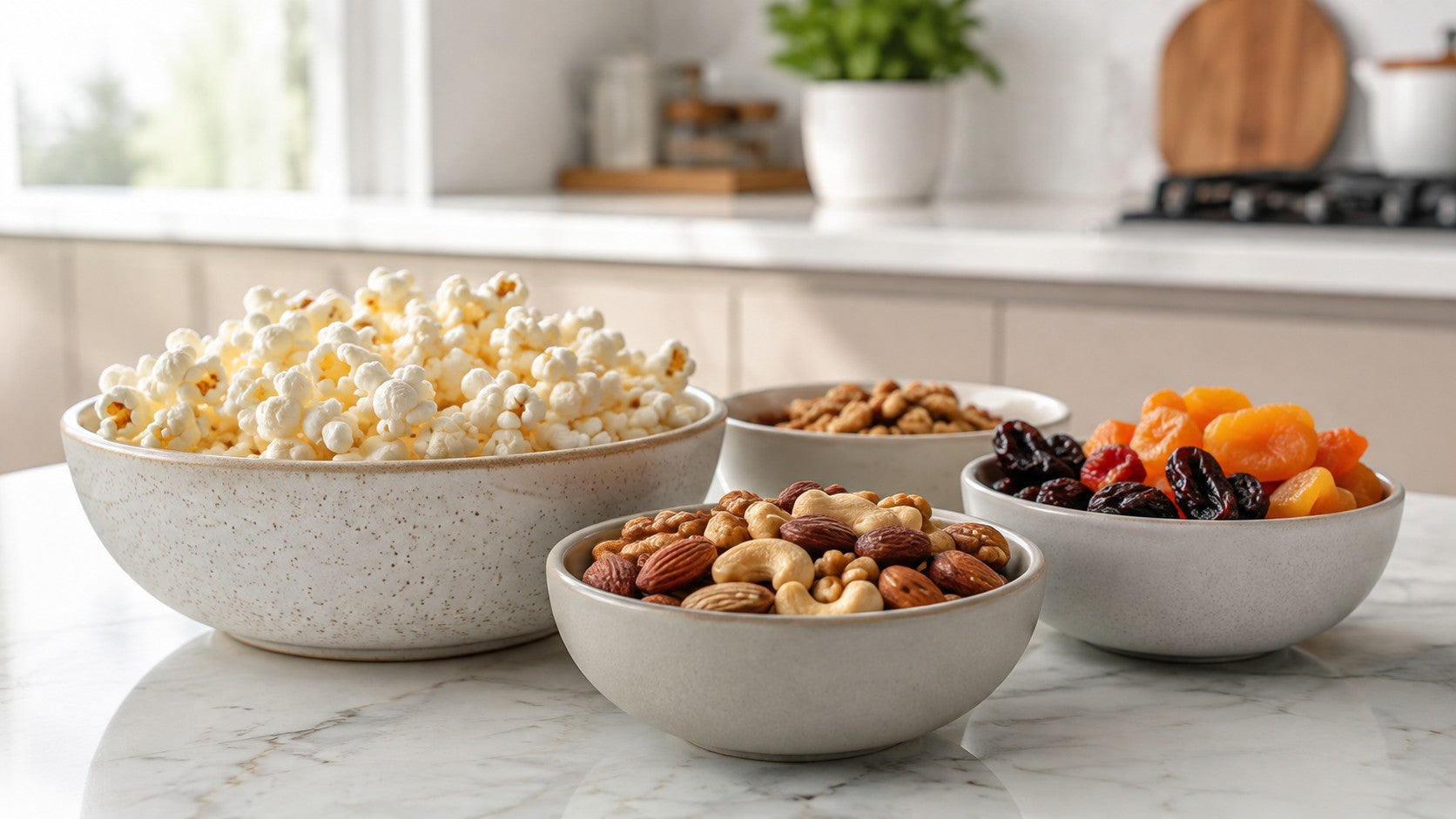
Trends in Healthy Snacking in Israel: What's Really Changing
While a few years ago snacking was just something you grabbed between meals, today it's a daily decision with real weight. Trends in healthy snacking in Israel show a sharp change: people are no longer just looking for something tasty with coffee or in front of the screen, but for a cleaner, faster, and more transparent solution. Fewer ingredients whose purpose is unclear, less unnecessary oil, less mess, and more control over what goes into the bowl.
This is no accident. Israeli homes have become busier, more aware, and also less patient with compromises. Parents want a snack their children will love without feeling like they've abandoned their principles. Students are looking for something quick that doesn't feel like industrial food. Those who are watching their weight are unwilling to waste an entire day on a small snack that came with too much salt, fat, or additives. And at the same time, more consumers are also paying attention to the packaging, waste, and raw materials surrounding the food itself.
Trends in Healthy Snacking in Israel Begin with Control
The clearest trend in the market is the shift from ready-made products to solutions that give the consumer control. Not just theoretical control, but practical control: how much salt to add, if any oil at all, what seasoning is suitable for children, what goes into the microwave, and what stays out.
This is a crucial point, because many products are sold under labels like "light," "natural," or "baked," but in practice, the list behind them is still long, processed, and sometimes confusing. The Israeli consumer of 2026 already reads labels better than before. Not everyone does it to the same extent, but the direction is clear: less trust in slogans, more interest in the ingredients themselves.
In simple terms, people want to know what they're eating without needing a dictionary. And when it's possible to make a snack from grains, legumes, yogurt, fruits, nuts, or other basic raw materials, the feeling is not only healthier, but also smarter.
Convenience No Longer Contradicts Health
There used to be a rather brutal division: either you cooked at home and made an effort, or you bought something ready-made and compromised on quality. One of the most interesting trends is that this gap is narrowing. Consumers are no longer willing to choose between convenience and health, and rightly so.
This means that products and preparation methods that manage to be both fast and clean are gaining a central place. Not because everyone has become a perfectionist, but because life itself demands better solutions. If preparing a healthy snack requires a pot, oil, mixing, cleaning, and a stove, it simply won't happen often enough. If, on the other hand, preparation is quick, organized, and mess-free, the chances of it becoming a habit increase significantly.
This is precisely why homemade popcorn is making a strong comeback, but in a different version. Not as a heavy, greasy cinema product, but as a basic, simple, and flexible snack. When made from kernels alone and with controlled seasoning, it meets several needs at once: crunch, a sense of indulgence, quick preparation, and personalized customization for every home.
The Israeli Consumer Seeks Short, Clean, and Clear
One of the most prominent trends is the preference for food with a simple message. Not "functional" only on paper, but something that can be understood in an instant. The cleaner the product is perceived to be, in its ingredients, preparation, and experience, the more it feels right for everyday life.
This is reflected in several layers. First, a short ingredient list. Then, a reduction in the burden of added sugar, sodium, or fat. And finally, in the preparation method. People want fewer strong odors in the house, fewer dishes in the sink, less feeling of having "conducted an operation" just for a small snack.
There's also an emotional aspect here. When a snack feels simple and clean, it's easier to incorporate it into a routine without guilt and without feeling like an indulgence. This may sound minor, but it's precisely what distinguishes a one-time treat from a regular choice.
Why Personalization Has Become a Basic Requirement
The Israeli palate is diverse, and within the same household, you can find those who prefer a mild saltiness, those who like spicy, those who prefer sweet and salty, and those who seek an almost unseasoned version. Therefore, personalization is no longer seen as a bonus. It's the expectation.
This is one reason why more "open" snacks, ones that allow for a neutral base and add-ons by choice, feel particularly relevant. They bridge different preferences without having to buy several separate products. Beyond that, they give a sense of control that extends beyond just health, to the eating experience itself.
In practice, this means more use of spices from the home kitchen, more experimentation with textures, and a shift from "what's in the package" to "how I want it to be." For families, it's a way to turn snacking into a short, fun activity. For young people, it's a way to get a quick result without feeling like they're eating a generic product.
Sustainability Enters the Kitchen, Not Just the Feed
Another clear change is that the environmental discourse is no longer just on the level of values. It reaches the shelf, the pantry, and the microwave. Consumers are more aware of what wraps their food, no less than what's inside it. Unnecessary packaging, industrial materials, and a sense of excessive disposability are starting to bother more people.
This doesn't mean every purchase has become an ideological statement. In most cases, the decision is entirely practical. If it's possible to choose a cleaner solution, without unnecessary materials and without excessive waste, and usage habits remain easy, many households will prefer it. Sustainability in Israel isn't always born out of activism. Sometimes it simply starts from a desire to reduce clutter, mess, and unnecessary materials at home.
This is also why simple, clear, and more ecological packaging feels like part of the product's overall quality today, not a side addition. The experience is perceived as more complete when the food and packaging speak the same language.
What's Actually Seen in the Israeli Kitchen
Looking at the habits themselves, one can identify a movement towards snacks with a clear base: popcorn from kernels, cut vegetables with simple dips, yogurt with toppings, fruits with nuts, and homemade versions of snacks that were previously only bought ready-made. Not everyone makes everything from scratch, and they don't have to. But there is a shift towards choices that give more control with less effort.
The snacking hour is also changing. It's no longer reserved just for evenings in front of a show. There are more in-between snacks between meetings, after school, before a workout, or as a small solution that sustains the day. Therefore, the criteria have become stricter: it has to be tasty, fast, satisfying, and not feel like a nutritional mistake.
It's interesting to see that the "indulgence" category has also been updated. In the past, indulgence was almost synonymous with excess. Today, more people understand that true indulgence is one that doesn't exact an unnecessary price. If you can enjoy a good crunch, a precise taste, and a comfortable experience, without excess oil, salt, or additives, it feels like an upgrade, not a compromise.
Where These Trends Get Stuck
It's also worth being honest: not every healthy-looking solution holds up in everyday life. Some products require too much preparation, some simply aren't satisfying, and some rely on a health message but miss the mark on taste. Ultimately, a snack must also be delicious. If it feels like a chore or a compromise, it won't survive beyond the first try.
There's also a matter of habit. A household accustomed to very dominant-tasting snacks won't always switch to milder options overnight. Sometimes an adjustment period is needed, and sometimes what works is not a complete replacement but a clever upgrade. For example, taking a familiar snack like popcorn, but preparing it in a way that reduces everything unnecessary and gives control back to the person eating it.
At Ecobubble, we built the brand precisely around this point. Our microwave paper bag was designed for reality as it is: people want healthier, but also fast, clean, and fun. Pour in the kernels, seal the closure, pop, and decide for yourself how much salt, what seasoning, and if any fat should be added.
The Israeli Brand That Embodies These Trends
Putting all the changes together, one demand emerges: a snack with one ingredient, minutes of preparation, full control over the taste, and packaging that doesn't leave a bad taste. This is where we stand.
- Paper bag only: no plastic coating, no PFAS, and no aluminum.
- No oil in preparation, and seasoning is determined after popping.
- Unique closure that does the job for you in 2-3 minutes.
- No pot, no appliance, and no dishes in the sink.
Anyone who wants to experience this trend in their kitchen is invited to start with a pack of Ecobubble bags for natural homemade popcorn, and upgrade the result with mushroom variety corn kernels, which pop large, round, and crispy.
Where the Market Goes From Here
It's likely that we'll see a continued strengthening of smarter snacks, not necessarily more complex ones. Fewer inflated promises, more clean solutions. Fewer products trying to impress with a list of "benefits," and more that simply do the job properly.
The direction is not an extreme return to the kitchen of old, nor a surrender to ready-made food without questions. Rather, it's a much more logical middle ground: simple raw materials, short preparation, personal control, and packaging that doesn't feel like part of the problem. This is especially true in homes where people eat together, but also for those who live alone and want a quick solution that doesn't clash with their lifestyle.
Trends in healthy snacking in Israel don't just tell us what people eat. They tell us what they are no longer willing to accept. Less fog, less clutter, less compromise. More transparency, more choice, more genuine convenience. And when a snack manages to be delicious, clean, and easy to prepare, there's a good chance it won't just be a trend, but a habit that sticks. For us at Ecobubble, it starts with our bag pack.
Read more
It's five in the afternoon, the kids are hungry, you're bouncing between Zoom calls and tidying the house, and nobody wants to start cooking. This is precisely when the question arises: how to make...
When you crave an evening snack, the problem is usually not hunger, but what comes with it. Many snacks provide a short-lived feeling of pleasure and then leave you with heaviness, thirst, and too ...