
How many calories are really in homemade popcorn?
If you've ever asked yourself how many calories are in homemade popcorn, you've probably already realized what many people miss: not all popcorn is created equal. The difference between a light, satisfying bowl and a snack that quickly racks up calories doesn't start with the popcorn itself, but with what goes into it: oil, butter, sugar, ready-made seasoning, and, of course, portion size.
The good news is that homemade popcorn can be one of the smartest snacks in the kitchen. It's simple, filling, quick to prepare, and when you start with just kernels, you have real control over everything that goes into the bowl. This is precisely the difference between a snack you eat on autopilot and a snack you manage.
How many calories are in homemade popcorn: The short answer
Homemade popcorn from kernels only, without oil or additions, is considered relatively low in calories. Generally, 100 grams of unpopped popcorn kernels contain approximately 370 to 390 calories. But we need to pause here, because most people don't eat 100 grams of kernels alone. After popping, that quantity becomes a very large bowl of popcorn.
In practice, a common homemade portion of 25 to 30 grams of kernels will yield approximately 95 to 120 calories before additions. This is already a nice amount of popcorn in a bowl. If you add a teaspoon of oil, you'll add about 40 calories. A tablespoon of oil will add about 120 calories. From here, the numbers start to climb quickly.
Therefore, when asked how many calories are in homemade popcorn, the precise answer is: it depends on how it's prepared. The base is relatively light. What's on top makes all the difference.
What determines how many calories are in homemade popcorn
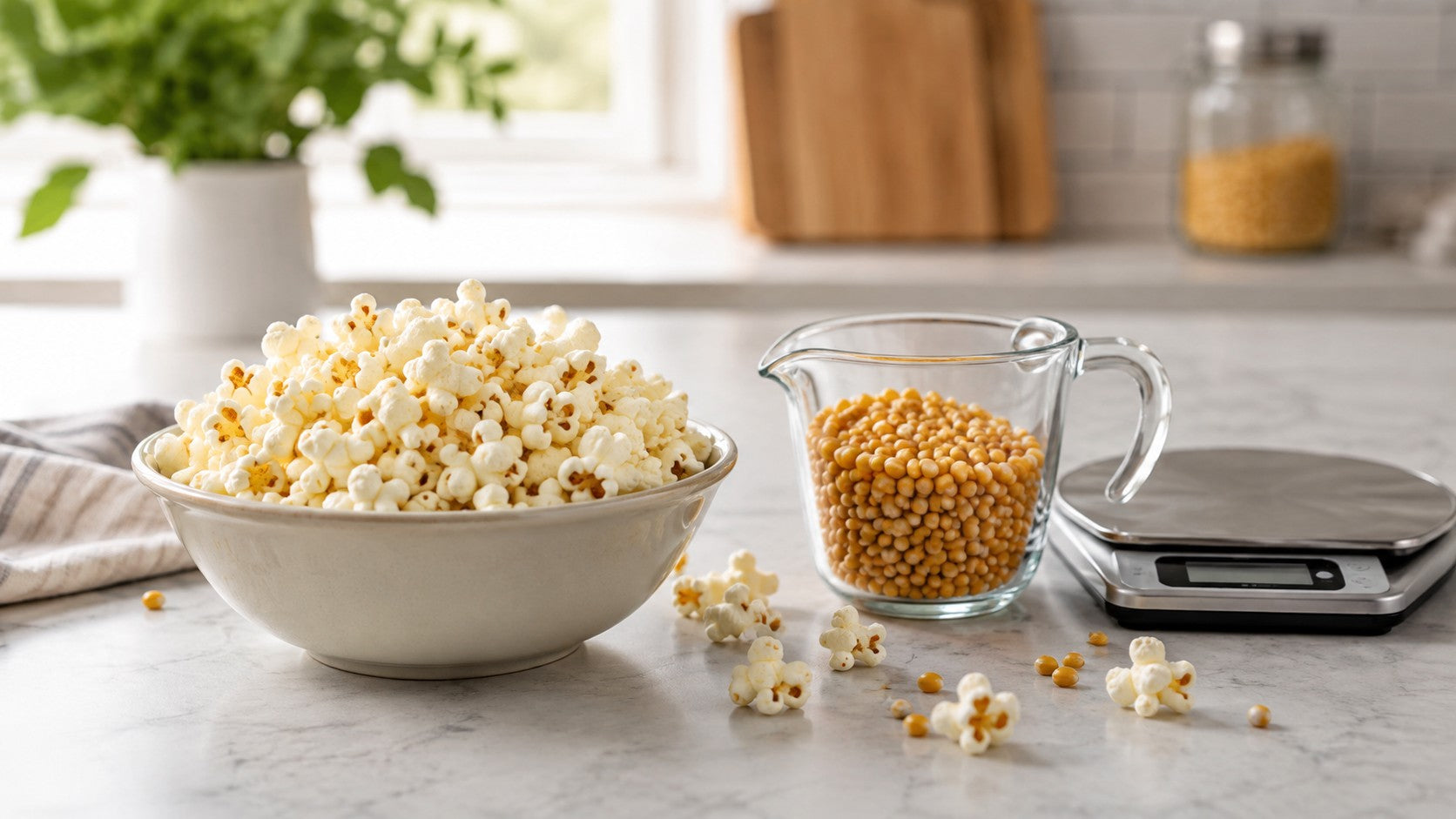
The first factor is the quantity of kernels. This sounds obvious, but many people measure popcorn by the size of the bowl after preparation, not by the amount that went in before. This is a classic mistake, because popcorn takes up a lot of volume. A huge bowl can start from a small amount of kernels.
The second factor is fat. Popcorn itself doesn't need oil to be a tasty snack, but as soon as oil, butter, or fatty sauces are added, the caloric value increases significantly. Even if it's a small addition, it's more calorie-dense than the kernels themselves.
The third factor is seemingly innocent additions. Flavor powders, caramel, chocolate, cheese, commercial seasonings high in sodium or sugar – all of these can turn a simple snack into a much less balanced treat. The problem isn't always just the calories. Sometimes it's also the feeling that you can keep eating without realizing it.
Simple calculation by serving size
To put things in order, here's a convenient way to think about it daily. 20 grams of kernels will yield approximately 75 to 80 calories. 30 grams of kernels will yield approximately 110 to 120 calories. 50 grams of kernels will already approach 190 calories.
Now let's add real scenarios. If you prepared 30 grams of kernels without oil, you're in the range of about 120 calories. If you added a teaspoon of oil, you'll reach around 160 calories. If you added a tablespoon of oil, you'll get close to 240 calories. And if there's butter or a sweet seasoning mix on top of that, the number continues to climb.
The implication is simple: you can enjoy homemade popcorn even when watching your weight, but it's advisable to measure the starting point. Not the bowl, but the kernels.
Homemade microwave popcorn versus stovetop popcorn with oil
Both methods can work, but in terms of calories, the difference usually comes from the oil, not the appliance. When cooking in a pot, many people add oil to prevent sticking and to get an even coating. This is entirely possible, but it also increases the caloric value faster.
When preparing in the microwave in a dedicated paper bag, you can make popcorn from kernels only and skip the oil entirely, or add very little if desired. Here there's both a practical and health advantage: less fuss, less mess, and more precise control over the amount of fat and seasoning. When you don't start with an industrial bag loaded with additives, it's much easier to know what you've eaten.
Based on this principle, we at EcoPop developed our paper bag for microwave popcorn: it works without a drop of oil, so the caloric calculation begins and ends with the kernels you measured.
This doesn't mean that every stovetop preparation is heavy, or that every microwave preparation is automatically lighter. It does mean that the cleaner and simpler the method allows you to work, the easier it is to keep popcorn as a balanced snack and not a disguised calorie trap.
Is homemade popcorn considered a diet snack?
Sometimes yes, but only if treated correctly. Popcorn is a whole grain, and it contains dietary fiber that contributes to a feeling of fullness. Compared to many salty snacks, it can be a more successful option, especially when prepared at home with control over the ingredients.
On the other hand, the word "diet" can be misleading. Even a light snack can easily become a high-calorie snack if you don't pay attention to the quantity of kernels and additions. This doesn't make popcorn a problem. It simply reminds us that its great advantage is control.
In other words, homemade popcorn is not a nutritional magic trick, but it is a smart choice when prepared simply.
How to make homemade popcorn lighter without compromising on taste
The best way to maintain balance is to start clean. Kernels alone are an excellent base, and then you can build flavor wisely. A little salt, paprika, dried garlic, nutritional yeast, cinnamon, or even za'atar can add character without overdoing it.
If you like seasoning that sticks well, you don't have to pour oil. Sometimes a very fine spray or clever stirring while the popcorn is still hot is enough. Here too, what matters is not only what you add but how much. Precise seasoning works better than heavy additions.
This is especially important for families with children. Popcorn can be a fun, quick, and satisfying snack, but it's very easy to accustom the palate to overly sweet or oily versions. When making it at home, you can keep the taste fun without turning it into a less successful habit.
How many calories are in homemade popcorn with common additions
Here the numbers start to change. Butter is the clearest example. Even a small amount quickly adds calories and fat. Caramel or sugar not only add calories but also make popcorn a snack that's easy to overeat.
Ready-made savory mixes can be less dramatic in calories, but they often come with a lot of sodium or processed ingredients that are less compatible with someone looking for a clean, simple snack. Therefore, it's better not to look only at the calorie count. Sometimes what's important is also the quality of the ingredients and your ability to identify exactly what's in the bowl.
If the goal is an everyday snack, it's better to choose a simple seasoning that you control. If it's a movie night treat, that's fine too, just know that it's no longer the same calculation.
The common mistake: measuring popcorn after preparation
One reason for the confusion surrounding how many calories are in homemade popcorn is that the volume is misleading. Popcorn expands greatly, so it looks like a lot of food even when the base is relatively small. This is actually a strength, because you get a satisfying bowl without starting from a large mass of raw material.
But if you try to calculate calories by cups or by bowl without knowing how many kernels went in, it's hard to get a reliable number. The simplest way is to measure the kernels before preparation, by spoon or by weight. After one or two times, you'll know exactly what quantity is right for you.
So what is considered a reasonable serving?
For most people, 25 to 30 grams of kernels is a good starting point for a personal snack. This amount provides a nice bowl, a decent feeling of fullness, and it's relatively easy to maintain a moderate calorie range. If preparing to share, you can simply double the amount and improvise less.
Anyone who exercises, maintains weight, or looks for an evening snack can benefit greatly here. Homemade popcorn doesn't have to be a heavy event. It can be a quick, clean, and precise solution, especially when there's a preparation method that starts with kernels only and gives you full control over what happens next.
The simple way to remove oil from the equation
Most of the unnecessary calories in popcorn don't come from the corn but from the oil and butter added along the way. EcoPop's paper bag solves this at the root: put in kernels, close with the unique fastener, 2-3 minutes in the microwave, and you get popcorn that popped with heat alone.
There's no oil in the bag and no ready-made seasoning, so you know exactly how many calories are in the bowl, and you decide for yourself whether to add anything on top.
- Without oil and without butter, the calories begin and end with the kernels
- Paper without plastic coating and without PFAS
- 2-3 minutes in the microwave, no pot and no dishes to wash
- A pack of bags, so it's easy to measure a consistent portion every time
Order the EcoPop natural homemade popcorn bag pack, and those who want a higher yield from every spoonful of kernels can add mushroom variety corn kernels that pop large and full.
There's something calming about a snack you don't have to guess about. No long ingredient list, no hidden excess oil, no unnecessary mess in the kitchen. Just kernels, quick preparation, and a taste you decide on. If you want to eat smarter without turning every snack into a project, the EcoPop bag pack is the shortest way there.
Read more
There's that moment when you make a bowl of popcorn at home, take one bite, and realize you were a bit heavy-handed with the salt. It happens quickly, especially when trying to compensate for homem...
If you've asked yourself whether popcorn in a pot or microwave is better, you're probably not just looking for a snack. You're looking for a solution. Something that will be tasty, quick, won't lea...