
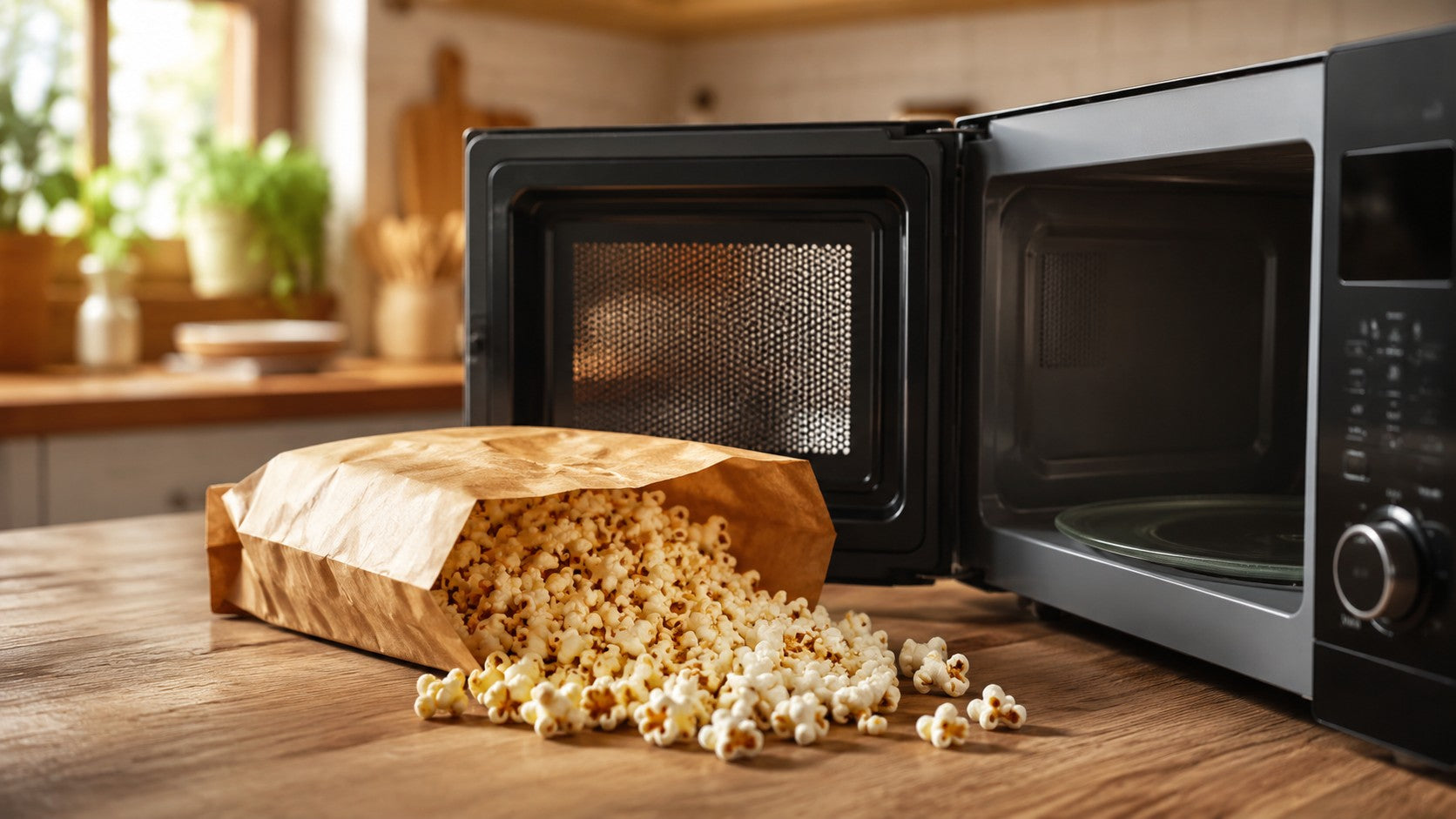
Is a paper bag suitable for the microwave?
Want hot popcorn in minutes without a pot, without unnecessary oil, and without a pile of dishes in the sink? Then the obvious question arises: Is a paper bag suitable for the microwave? The short answer is yes, but not every paper bag. The difference between a bag suitable for such use and a random bag from the pantry is precisely what determines whether you get a convenient and clean solution, or an experiment not worth trying at home.
Is a paper bag suitable for the microwave: The full answer
Paper, as a raw material, can be suitable for microwave heating under certain conditions. A microwave does not heat "the bag" like an oven, but rather applies energy to molecules in the food and liquids within it. Therefore, plain, clean, and dry paper, without problematic additives, can undergo short and relatively safe heating.
The problem begins when people say "paper bag" as if all bags are identical. They are not. There are bags with adhesives, dyes, handles, windows, grease-resistant coatings, reinforcing layers, or materials not designed to be exposed to high heat. There are also bags designed for storage or delivery, not for food preparation. In such a case, the mere fact that they are made of paper does not make them a suitable choice for the microwave.
If the goal is to prepare food, especially popcorn, you need to think not only about "will it heat up," but about three simple things: Is the material clean and suitable for contact with food, are there no hidden layers, and is it specifically designed for the microwave? When these three conditions are met, the experience is completely different: simpler, cleaner, and much more relaxed.
Why not every paper bag is suitable for the microwave
Many people assume that if parchment paper or a certain paper towel can go into the microwave, then a brown paper bag from the bakery will also do the job. This sounds logical, but it's an unsuccessful shortcut. Different bags are produced for different purposes, and their composition is not always visible to the eye.
Some bags contain glue in the folded or sealed areas. Others are printed with ink not designed for heating. Some bags have a thin inner layer that helps with resistance to grease or moisture, but is not suitable for microwave use. Even if the bag looks simple, it's difficult to know what's in it without clear information from the manufacturer.
This is where the difference between "might work" and "designed for it" comes in. When a bag is pre-designed for microwave food preparation, there's no need to guess. It should provide a more consistent result, with less risk of off-odors, scorching, or contact with materials you wouldn't choose to put in your food.
What about a regular brown paper bag?
Sometimes you see recommendations online to use a simple brown lunch bag for making popcorn. In practice, this is a gray area. If it's a clean paper bag, without prints, without coatings, and without metal parts, some people use it for short heating. But it's still not an ideal choice, as there's no full certainty regarding its durability or the materials used in its production.
If you're looking for a permanent solution for the family, for movie night, for a quick snack after school, or for a late-night student meal, it's better to choose what was designed for the task. It's not just a matter of convenience; it's also a question of controlling what touches your food.
When a paper bag IS suitable for the microwave
A paper bag can be suitable for the microwave when it adheres to a few simple principles: it is intended for food, intended for microwave heating, made of paper without plastic or aluminum, and without unnecessary industrial coatings. This is especially true when making popcorn from kernels only, because here the bag needs to withstand heat, steam, and the movement of the kernels during popping.
In other words, suitability for the microwave is not solely a property of "paper," but of the entire product. Just as not all glass dishes are suitable for the oven, not every paper bag is suitable for the microwave.
When using a dedicated bag, the advantage is immediately noticeable. There's no need to add a pre-made mix, no reliance on bags loaded with oil and additives, and no fuss with a pot, lid, and splashes on the stove. Simply fill, close, heat, and season to taste.
This is precisely why we at Ecopop created the ecological paper bag for making popcorn in the microwave: plastic-free paper, PFAS-free, with a unique closure that keeps the bag sealed throughout heating. Add kernels, close, 2-3 minutes in the microwave, and season exactly as you like.
How to identify a paper bag that should NOT be put in the microwave
If there's no clear marking that the bag is microwave-safe, it's best not to gamble. This is especially true if you see a colorful print, a glossy layer, a transparent window, a complex glued seal, or if it feels "coated" to the touch. Recycled bags not directly intended for food contact are also not the place for experimentation.
Another warning sign is smell. If the bag has an industrial smell, ink smell, or chemical smell even before heating, there's no reason to bring it near hot food. A microwave won't make it disappear; it might just emphasize the problem.
It's also worth remembering that excessively long heating times, even in a suitable bag, can cause scorching. Therefore, correct usage is always a combination of suitable material and proper operation. It's not enough for the bag to be good; you also need to stop in time.
What makes a dedicated popcorn bag a better solution
When a bag is pre-designed for microwave popcorn preparation, the entire process becomes more precise. It's built to handle heat and steam, allows kernels to pop well, and maintains a quick preparation experience without introducing unwanted materials.
This is where the health benefit comes in too. Instead of a ready-made bag with a long list of ingredients, you can start with kernels only. You choose whether to add salt, how much to add, and whether to use oil at all. Want a clean taste? Go for natural popcorn. Want to upgrade? You can later add a little olive oil, nutritional yeast, smoked paprika, or cinnamon. The control remains with you.
From a sustainability perspective, there's a real difference here too. Those looking for less household waste and fewer unnecessary packaging materials don't want to discover that "paper bag" hides additional layers of materials. A dedicated, simpler, and cleaner paper bag is much more suitable for the approach of a conscious household, one that wants convenient solutions without sacrificing responsibility.
Is a paper bag suitable for the microwave for heating other foods too?
Sometimes yes, but here even more caution is needed. Popcorn is a relatively simple case, as it's a dry food with a short heating time. Moist, fatty, or heavier foods create different conditions: more steam, more hot spots, and sometimes a greater chance of softening or damaging the bag.
Therefore, even if a certain bag is suitable for making popcorn, it doesn't mean it's intended for every type of heating. It's advisable to stick to the product's original purpose. If it was designed for popcorn, use it for popcorn. This is the right way to avoid disappointment and also to maintain a good result.
What about bread, pastries, or short heating?
A regular paper bag is sometimes used for short heating of a pastry or sandwich, but this doesn't make it a blanket recommendation. Again, the question is not just whether it "works," but whether it's suitable and safe. When there's no clear information, it's better to choose a container or wrapper designed for the microwave and not improvise.
A bag designed for the microwave, without guessing
At Ecopop, we built an ecological paper bag whose sole purpose is one: to make popcorn in the microwave, clean and fast. It has no plastic coating, no PFAS, and no need to add oil. The unique closure keeps the bag sealed while the kernels pop, so there are no splashes and no overturned bowl.
You fill your own kernels, put it in the microwave for 2 to 3 minutes, and season to your taste. No pot, no standing and stirring, and no dishes in the sink.
- Plastic-free and PFAS-free paper, intended for food contact and microwave heating
- Unique closure that eliminates rubber bands, clips, or improvised folds
- Popcorn ready in 2 to 3 minutes, without oil and without watching the pot
- Full control over salt and seasoning, and zero dishes to wash
You can start with an Ecopop bag pack for natural homemade popcorn, and complete the experience with mushroom kernels that pop large, round, and crunchy.
What to remember: for parents, students, and anyone who loves smart solutions
If you've asked yourself whether a paper bag is suitable for the microwave, the correct answer is: sometimes yes, but only when it's the right bag. Not all paper is the same, and not every innocent-looking bag is a good choice for heating food. When putting food in the microwave, especially for children or for regular home use, it's best to prefer certainty over guesswork.
The smart choice is a dedicated, clean, and simple bag, without plastic, without aluminum, and without unnecessary coatings. Exactly the kind that allows you to make popcorn from kernels only, enjoy the speed of the microwave, and maintain full control over what goes into the bowl. It's also convenient, clean, and much more aligned with those who want less processed food, less mess, and more logic.
Ecopop is built precisely on this idea: to take the convenience people love, and leave out everything unnecessary. The next time you reach for a random paper bag, stop for a moment and choose a bag designed for it: order an Ecopop bag pack and enjoy simple, clean, and quick homemade popcorn.
Read more
Some products don't seem dramatic at first glance, but then they solve several everyday problems at once. A review of an eco-friendly popcorn bag starts exactly there: between the desire for a quic...
When searching for a review of uncoated popcorn bags, you're usually not just looking for a bag. You're looking for a way to make a quick snack without compromising on what goes into it, without a ...