
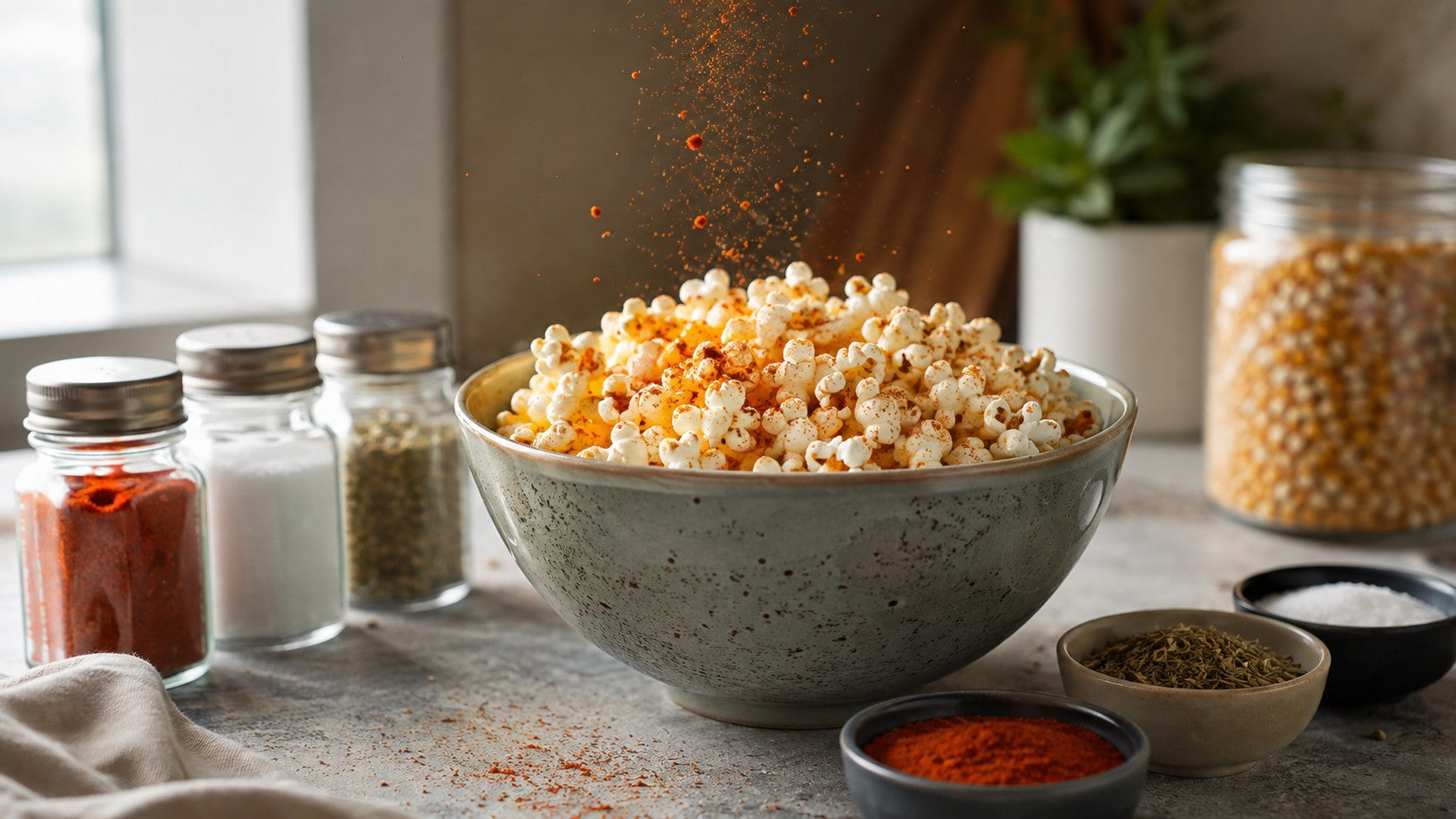
How to control popcorn seasoning at home
You’ve made popcorn at home, it came out fresh, hot, and crispy, but then something went wrong with the seasoning. Sometimes it’s too salty, sometimes the spices stay at the bottom of the bowl, and sometimes you add butter or oil “to make it stick,” ending up with a snack heavier than you intended. This is precisely where the question of how to control popcorn seasoning, not just how to add flavor, begins.
True control doesn't start with the spice itself, but with three simple things: when to season, what the seasoning sticks to, and what size the seasoning mixture is. When you understand this, it's much easier to achieve perfectly seasoned popcorn, suitable for children, for entertaining, for a light evening snack, or for a bolder version when you want something special.
How to Control Popcorn Seasoning Without Overdoing It
The most common mistake is thinking that more spice will solve everything. In reality, if the base isn't right, even an excellent blend won't sit well on the popcorn. Successful seasoning is a balance between even coverage and maintaining the crispy texture. As soon as too much liquid is added, the popcorn can soften. As soon as too coarse a powder is sprinkled, it simply falls off.
Therefore, it's best to think of seasoning in layers. First, create a very delicate, not overwhelming, gripping layer for the popcorn. Then, sprinkle a fine seasoning, and only then taste and decide if more is needed. This approach sounds minor, but it's the difference between "okay" popcorn and popcorn that feels thoughtfully prepared.
First Rule: Season While the Popcorn is Still Hot
Hot popcorn absorbs seasoning better than cooled popcorn. The heat doesn't make spices stick on its own, but it does help fat or delicate moisture spread better over the surface. If you wait too long, the seasoning will sit less evenly and require more material to be felt.
This is especially important when trying to reduce salt or oil. When the seasoning adheres correctly from the start, there's no need to "compensate" with quantity.
Second Rule: Delicacy Wins
If you want control, start with a little and add gradually. It's much easier to correct mild popcorn than to save an overly salty bowl. This is especially true with fine salt, garlic, dried cheeses, cocoa, cinnamon, or smoky blends, flavors that open up quickly.
A good way to work is to season half of the popcorn, mix, taste, and only then continue. This sounds basic, but at home, it's precisely what prevents mistakes.
The Base That Holds the Seasoning
For the seasoning to stick well, it needs something to adhere to. It doesn't have to be a lot, but it does have to be something. This is where one of the big advantages of home preparation comes in: you decide if you even need fat, what kind of fat, and how much.
Some prefer a hint of delicate olive oil, some like a little melted butter, and some prefer a lighter solution like a very fine spray of oil. All options can work, as long as the quantity is small. The goal is not to wet the popcorn, but only to create an almost imperceptible layer.
If you want to reduce fat, you can also work with very fine seasoning on very hot popcorn and mix immediately. It won't stick as well as with an adhesion layer, but with the right powder and good mixing, you can achieve a surprising result. There's no single right answer here; it depends on whether you prefer a more pronounced flavor or a cleaner, lighter version.
Why Seasoning Size Matters More Than the Blend Itself
Fine powder sticks better. This is true for salt, sugar, spices, and even nutritional yeast or dried cheese. If the mixture is coarse, some of it will fall to the bottom of the bowl, and the taste will be uneven. If it's finely ground, every bite will feel more balanced.
Therefore, if you're working with homemade spices, it's sometimes worth grinding or crushing them a little before use. Paprika, dried garlic, onion powder, fine black pepper, cinnamon, or cocoa work better when their texture is delicate. Fine salt or finely ground salt will also give a more precise result than coarse salt.
How to Control Popcorn Seasoning by Flavor Type
Not every flavor behaves the same way. Salty, sweet, or spicy seasoning requires a different ratio of powder, fat, and intensity.
Salty Flavors
Salty popcorn sounds simple, but it's precisely where over-salting easily happens. The reason is that salt is quickly perceived, but not always evenly distributed. If part of the bowl is almost unsalted and another part is overloaded, there's an urge to add more, and then everything goes over the limit.
To avoid this, it's best to use very fine salt and sprinkle it in a few short rounds while stirring. If you want depth without excess sodium, you can combine a little dried garlic, mild paprika, or nutritional yeast. This creates a fuller flavor sensation without relying solely on salt.
Sweet Flavors
With sweet popcorn, the problem is usually the opposite: the sugar doesn't stick. Powdered sugar, fine cinnamon, and cocoa work better than granulated sugar. Here too, a delicate adhesion layer helps greatly, but you need to be careful not to overload it so that the popcorn doesn't lose its crispness.
If you want a delicate sweet flavor, it's better to build it in a very thin layer. If you want a more dessert-like flavor, you can mix the powders in advance and then sprinkle. Sweet seasoning requires a light hand and patience, because too sharp a transition makes everything heavy.
Spicy or Pronounced Flavors
Chili, pepper, smoky blends, or other strong spices need balance. In popcorn, there isn't much to absorb the intensity, so they are perceived faster than in other dishes. Simply put, it's easy to go past the right point.
Instead of sprinkling a hot spice directly, it's better to mix it first with a milder base like fine salt, dried garlic, or paprika. This makes the distribution more even and the flavor more controlled.
The Most Convenient Method at Home
If you make popcorn often, it's worth adopting a regular method. Prepare the popcorn, immediately transfer it to a large bowl or leave it in a container that allows safe shaking, add a minimal adhesion layer, sprinkle fine seasoning, and immediately shake or stir. Taste only after thorough mixing.
This order is important. When working quickly, the flavor adheres better, and less seasoning is needed. When working slowly or haphazardly, you usually end up with more fat, more salt, and less precision.
This is precisely why simple and clean preparation tools make a difference. At EcoPop, we built an ecological paper bag for microwave popcorn that comes without plastic coating and without PFAS, and requires not a drop of oil. The popcorn comes out completely neutral, and this is precisely the situation where the seasoning is 100% under your control.
Small Mistakes That Ruin a Good Result
There are a few mistakes that recur in almost every kitchen. The first is adding oil "just to be safe." In reality, excess oil doesn't create more flavor; it only makes it heavy and soft. The second is using spices that are too coarse. The third is seasoning after the popcorn has already cooled.
Another common mistake is trying to build flavor from only one ingredient. Often it's better to combine two or three delicate flavors than one strong one. For example, salt with dried garlic will feel deeper than salt alone. Cinnamon with a little powdered sugar will feel more complete than cinnamon alone. The combination gives a sense of richness, without being overwhelming.
The size of the bowl also matters. If the bowl is too small and there's no room to mix, the seasoning will remain in the top layer. A wide bowl or a container that allows shaking provides a much more uniform result.
How to Build Your Own Signature Style
Once you understand the principle, you can create a consistent pattern at home that suits you. Families with children will generally prefer clean, delicate, and clear flavors. Someone looking for an evening snack might want a salty depth without a lot of oil. Those who enjoy entertaining will prefer a slightly more surprising combination, but still one that remains pleasant and not tiring.
The best way is not to chase after one "perfect" recipe, but to choose a basic ratio that works for you and play around with it. For example, decide in advance whether you like delicate or pronounced seasoning, whether you prefer minimal fat or are willing to add a little for better adhesion, and whether your popcorn is more of an everyday snack or part of an experience. Once you have answers to this, seasoning stops being a guess.
Seasoning Control Starts with a Clean Base
You can't control the taste of popcorn that's already been seasoned. Commercial bags come with oil, salt, and flavorings determined at the factory, and all you can do is add to them. At EcoPop, the direction is opposite: you pour your kernels into the bag, microwave for 2-3 minutes, and season exactly to your taste.
The bag is made of paper only, with a unique closure that holds the kernels in place, without plastic coating and without PFAS. No pot, no need to stand and watch, and no dishes to wash afterward.
- Completely neutral base, without oil and without pre-salt
- Full control over the amount and type of seasoning
- Clean paper without plastic coating and without PFAS
- Ready in 2-3 minutes, without a pot and without dishes to wash
You can order the EcoPop Home Natural Popcorn Bag Pack and upgrade the result with Mushroom Kernel Corn, which pop large, round, and crispy and hold seasoning much better.
Good popcorn doesn't have to be overloaded to be exciting. When you control the timing, quantity, and texture of the seasoning, every bowl feels more precise, and it's precisely the simplicity that makes it successful. If you want to start with the right foundation, grab an EcoPop Bag Pack and the seasoning will be yours.
Read more
The first pop always sounds like a promise for an easy evening. The problem starts a second later: a pot that needs washing, oil that's hard to measure, or a ready-made microwave bag that doesn't r...
If you also get a craving for popcorn quickly, during a movie night, between classes, or just before the kids ask again "Is there anything to snack on?", it's likely you've already looked for where...