
How to Reduce Kitchen Waste Without Getting Complicated
The trash can in the kitchen doesn't fill up by chance. Usually, it's not the leftovers from a Friday night dinner that overwhelm it, but a constant stream of small things: single-use packaging, vegetables forgotten in a drawer, bags, wrappers, and food bought with good intentions but never planned to be used. If you're asking how to reduce kitchen waste without starting to manage an Excel spreadsheet for every tomato, the good news is it's much simpler than it seems.
The right approach doesn't start with perfectionism. It starts with control. Less automatic buying, more intelligent use. Fewer unnecessary packages, more clean solutions that work in everyday life. When you make a few small and correct changes, the kitchen becomes a more efficient, cleaner, and calmer place.
How to Reduce Kitchen Waste Through Smart Shopping
A lot of waste is created even before we get home. We buy quickly, are tempted by sales, take too large quantities, and then find out that half of the purchase wasn't suitable for our week. This happens in families, among students, and even among those who cook excellently, simply because life moves fast.
To reduce waste, you don't need to buy less of everything. You need to buy more precisely. Basic planning of three or four main meals for the week already changes the picture. Once you know what the vegetables, grains, or snacks you buy are for, there's less chance they'll be forgotten in a corner and thrown away.
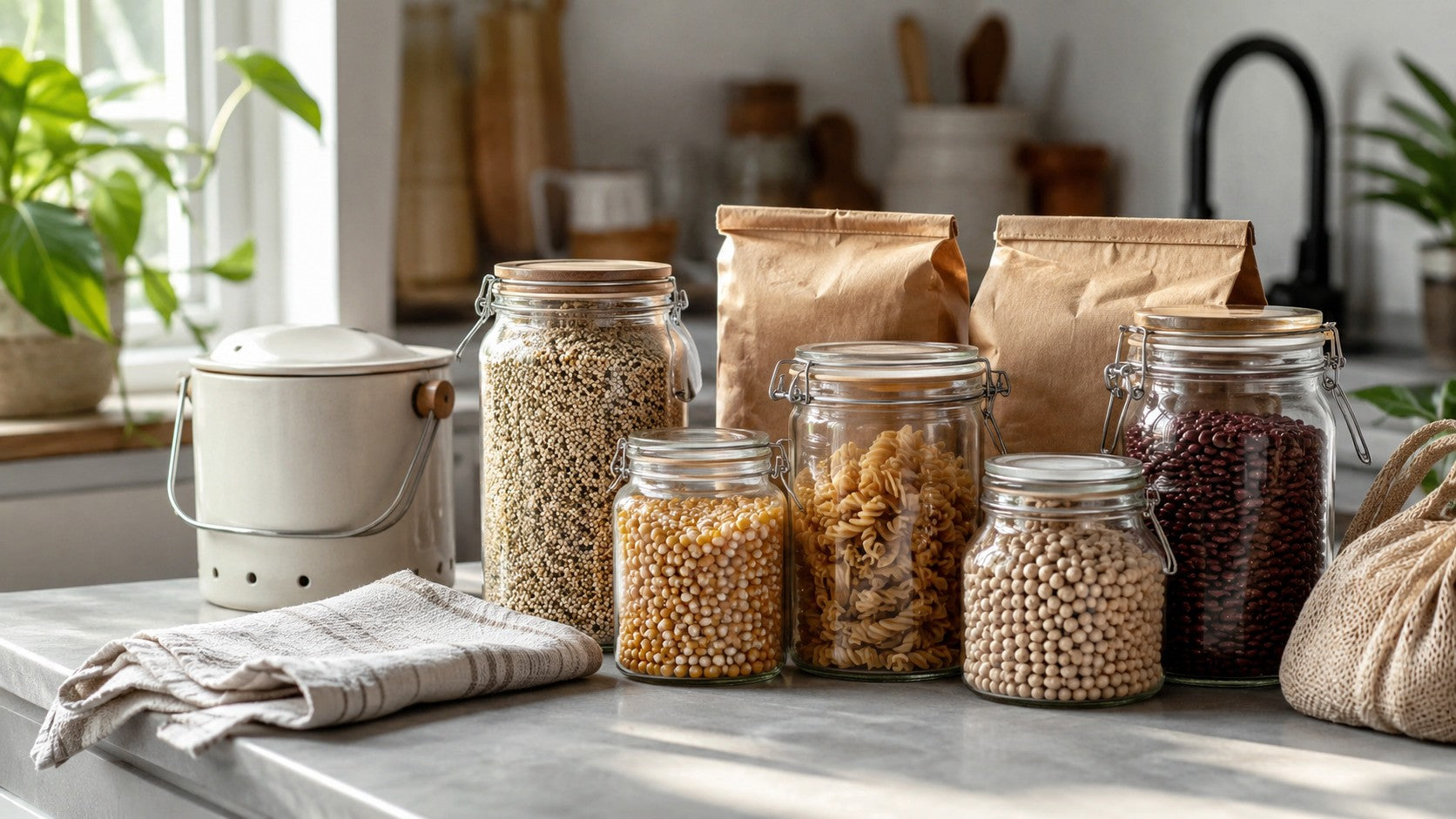
The size of the packaging also matters. Sometimes a large package seems economical, but if part of it is thrown away, it's a less efficient choice. For products you don't consume regularly, it's better to choose an amount you will finish. For dry products you do use a lot, like legumes, rice, or popcorn kernels, precise buying and proper storage can reduce both food waste and unnecessary packaging over time.
Not Every Sale is a Saving
Some sales actually create more waste. If you bought three units just because it was a good deal, but one was left behind until it expired, you saved nothing. This doesn't mean giving up smart shopping, just asking one simple question: Will this be eaten, or does it just look like a good idea on the shelf?
Less Packaging, More Control
One of the biggest sources of waste in the kitchen is overly prepared food. An individually wrapped portion, a snack in a bag inside a box inside a wrapper, quick solutions that create a surprisingly large pile of trash. The convenience is real, but the environmental and daily cost is high.
This is exactly where it pays to switch to solutions that offer convenience without all the unnecessary layers. For example, when making snacks at home from simple ingredients, you can control the quantity, taste, and what is thrown away along the way. This applies to cut fruit in a reusable container, pre-made interim meals, and even homemade popcorn that starts from kernels and not an industrial product overloaded with packaging and additives.
When you have clean and quick solutions at home, it's easier not to fall back on defaults that generate more waste. This is precisely why smart products succeed: not because they are perfect on paper, but because they make it easier to make a good choice at the moment of truth.
What to Do with Leftovers Before They Become Waste
In most kitchens, the big problem isn't just what goes into the trash, but what goes into the fridge in the hope it will sort itself out. A container of rice, half a salad, two slices of sweet potato, leftover sauce. Each one is small, but together they become almost certain waste.
The best way to deal with this is not to wait. Leftovers need a destination. Rice can turn into patties, roasted vegetables can go into an omelet or a sandwich, and overly soft fruits can become a smoothie. When you decide in advance that leftovers are raw material and not an end, much less food goes to waste.
How to Reduce Kitchen Waste with an "Eat Me Now Shelf"
A simple trick that works in almost every home is to dedicate one area in the refrigerator to food that needs to be eaten first. You don't need fancy containers or a complex labeling system. Just one clear, visible shelf. Anything approaching its end moves there.
It sounds small, but it changes behavior. Instead of forgetting, you see. Instead of buying more, you use what you already have. In an active kitchen, visual cues are no less important than good intentions.
Proper Storage is Not a Bonus
Sometimes waste is created simply due to improper storage. Herbs rot quickly, bread dries out, leafy vegetables become limp within a day. The problem isn't always that we bought too much; sometimes we just didn't give the food the conditions to last.
It's worth knowing a few basic principles: separate vegetables that release ethylene gas from sensitive vegetables, don't wash everything immediately if it shortens shelf life, and use airtight containers for dry products to maintain freshness and prevent duplicate purchases. When food is stored well, there's more time to use it.
This is also where simplicity wins. If every use requires a procedure, we won't stick with it. A good solution is one that helps preserve, see, and retrieve quickly.
Kitchen Waste Also Starts with Cooking Habits
There are homes where too much food is prepared almost every meal. This stems from good intentions, but sometimes it creates a constant cycle of surpluses, containers, and eventually, disposal. On the other hand, overly precise cooking can lead to ordering out and more packaging. Therefore, the answer is balance.
It's advisable to cook with the intention of useful excess, not accidental excess. For example, prepare a double quantity of one ingredient that can be incorporated into several different meals. Rice, lentils, oven-roasted vegetables, or toasted kernels can work in several directions. In contrast, preparing a huge pot of a dish that no one will want to eat tomorrow is less of a strategy and more of a gamble.
Cooking utensils also have an impact. When it's easy to prepare, it's easier to choose homemade. When there's less mess and less fuss, one is less tempted by disposable and overly packaged solutions. This is precisely why people today seek products that reduce steps without adding unnecessary ingredients.
Snacks Are a Weak Point That Can Be Fixed
In many kitchens, daily waste comes precisely from snacks. A bag here, a wrapper there, one small product that runs out quickly and leaves a lot behind. It's convenient, but it accumulates very quickly.
Instead of buying endless snacks in small packages, you can keep simple staples at home and make them accessible. Popcorn is an excellent example because it can be quick, tasty, and precise, without resorting to unnecessary oil, without a long list of ingredients, and without complex industrial packaging. At Ecopop, we developed a paper bag for making popcorn in the microwave for this very purpose, without plastic coating, without aluminum, and without PFAS. The preparation is short and clean, and what's left at the end is one paper bag.
Of course, not every home will eat popcorn every day, and that's precisely the point. The goal is not to replace every product in the kitchen, but to identify where waste is recurring and change it there.
You Don't Have to Go Zero Waste to See a Change
One reason people don't start reducing waste is the feeling that a revolution is needed. Buying everything new, changing the whole kitchen, transitioning to a trash-free life. In practice, this usually doesn't last. What does last is consistent improvement.
If you change two or three regular habits, you'll already feel the difference. Less forgotten food, fewer wrappers, fewer bags, less mess on the counter. The change is noticeable in the trash, in time, and in the sense of control.
There are also cases where waste reduction won't be the most perfect choice at every moment. Sometimes during busy periods, quicker solutions are needed. Sometimes a home with children will prefer convenience even if it's not environmentally optimal. That's okay. The goal is not perfection, but a kitchen that works better for you, with less waste along the way.
How to Maintain It Long-Term
For change to last, it must be easy to implement. Choose one point to start with this week: an organized leftovers shelf, more precise shopping, switching to snacks with less packaging, or regular use of containers for dry food. Don't try to change everything in one day.
When the kitchen is well-planned, it's easier to eat well. And when it's easier to eat well, less waste is created almost without noticing. It's not magic, but the result of small choices that work together.
One Small Change That Makes a Difference in the Trash
A commercial microwave popcorn bag comes with an inner coating, oil, salt, and pre-determined additives. Ecopop's bag is made of paper only, without plastic coating, aluminum, or PFAS, and has a unique closure that keeps the kernels inside. You pour in your kernels, microwave for 2-3 minutes, and season at the end exactly as you like.
No pot, no oil, no dishes to wash. The pack lasts a long time, so instead of dozens of small packages, one organized purchase enters the home.
- Paper only, without plastic coating, aluminum, or PFAS
- One package instead of a separate bag for each snack
- Loose kernels that store for months in the cupboard
- No oil, no dishes, and no water for washing
You can start with Ecopop home natural popcorn bag pack and add fungus-type corn kernels that pop large, round, and crispy.
If your kitchen trash can fills up too quickly, it's not asking you to be perfect. It's just indicating that there's room for a simpler, cleaner, and smarter solution. If you want to take the first step today, order an Ecopop bag pack and see how much less is left in the trash.
Read more
There's a moment in the middle of the day when you don't need a full meal, but you also don't want to fall back on something heavy, greasy, or ultra-processed. Exactly for these moments, we've gath...

In the evening, it almost always happens the same way: you look for a small snack while watching a show, between folding laundry and the kids' showers, or right before closing the kitchen. The prob...